Superwall CLI
Set up the SDK, manage products, campaigns, and paywalls, query your analytics data, and call the API from your terminal or coding agent using the Superwall CLI.
The Superwall CLI brings your whole Superwall account to the terminal: set up the SDK in your app, manage products, campaigns, and paywalls, run SQL against your analytics data, and call the Superwall and App Store Connect APIs. It's built for humans and coding agents alike, so everything it can do, your agent can do too.
The CLI is also what powers the Superwall Skill. Installing the skill teaches your coding agent to use these commands on your behalf, so you rarely need to memorize them. This page is the full reference for when you're driving the terminal yourself, or want to know exactly what your agent can do.
Installation
Install the CLI globally with npm, then log in:
npm install --global superwall
superwall login
You can also run it without installing via npx superwall. The package installs two commands that behave identically: superwall and the shorter sw.
The CLI tells you when a new version is available. Update any time with:
superwall upgradeAuthentication
superwall login opens your browser once, and every command shares that session. The session is stored in ~/.superwall.
superwall login     # opens the browser
superwall whoami    # shows the logged-in account
superwall logout    # ends the session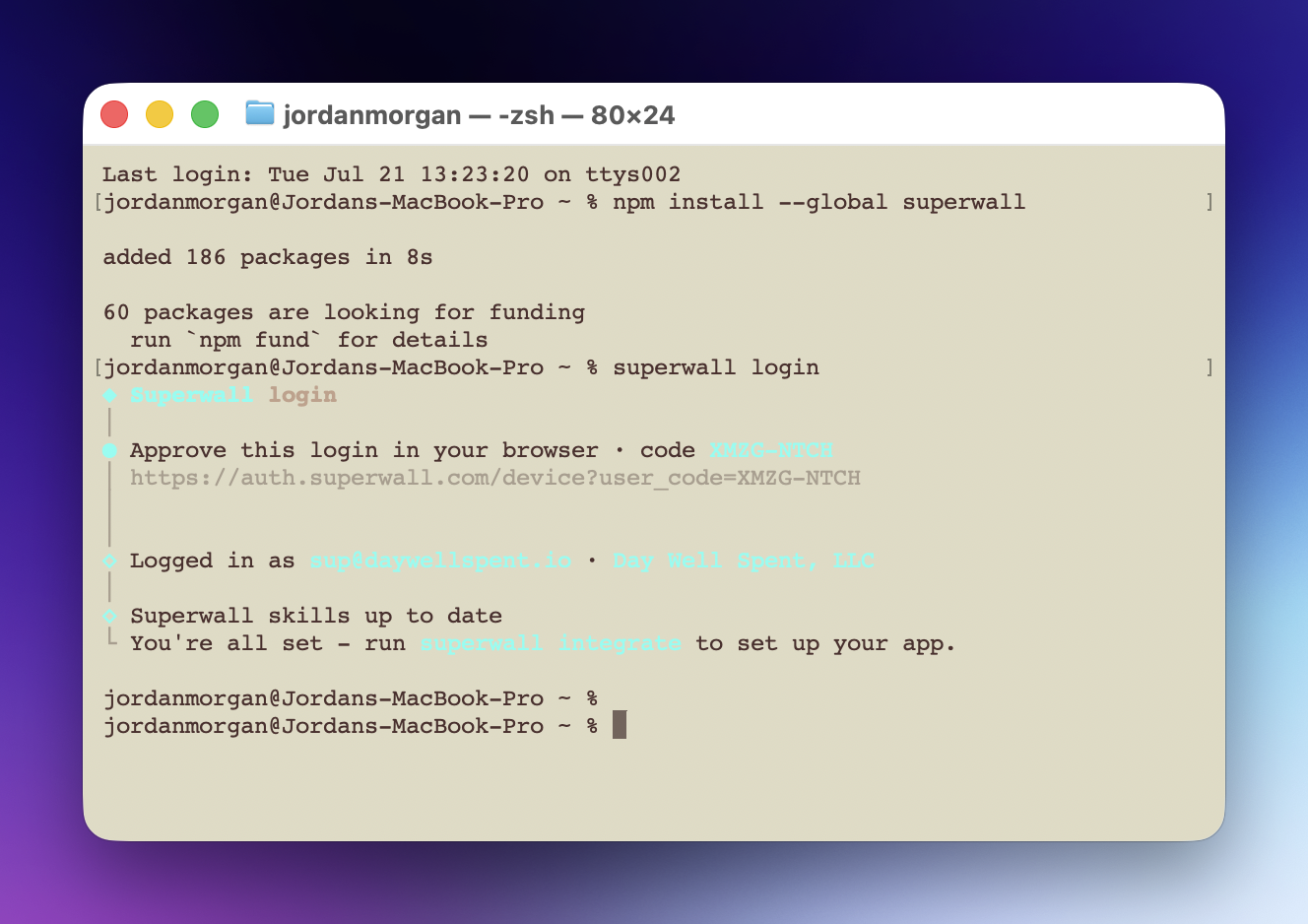
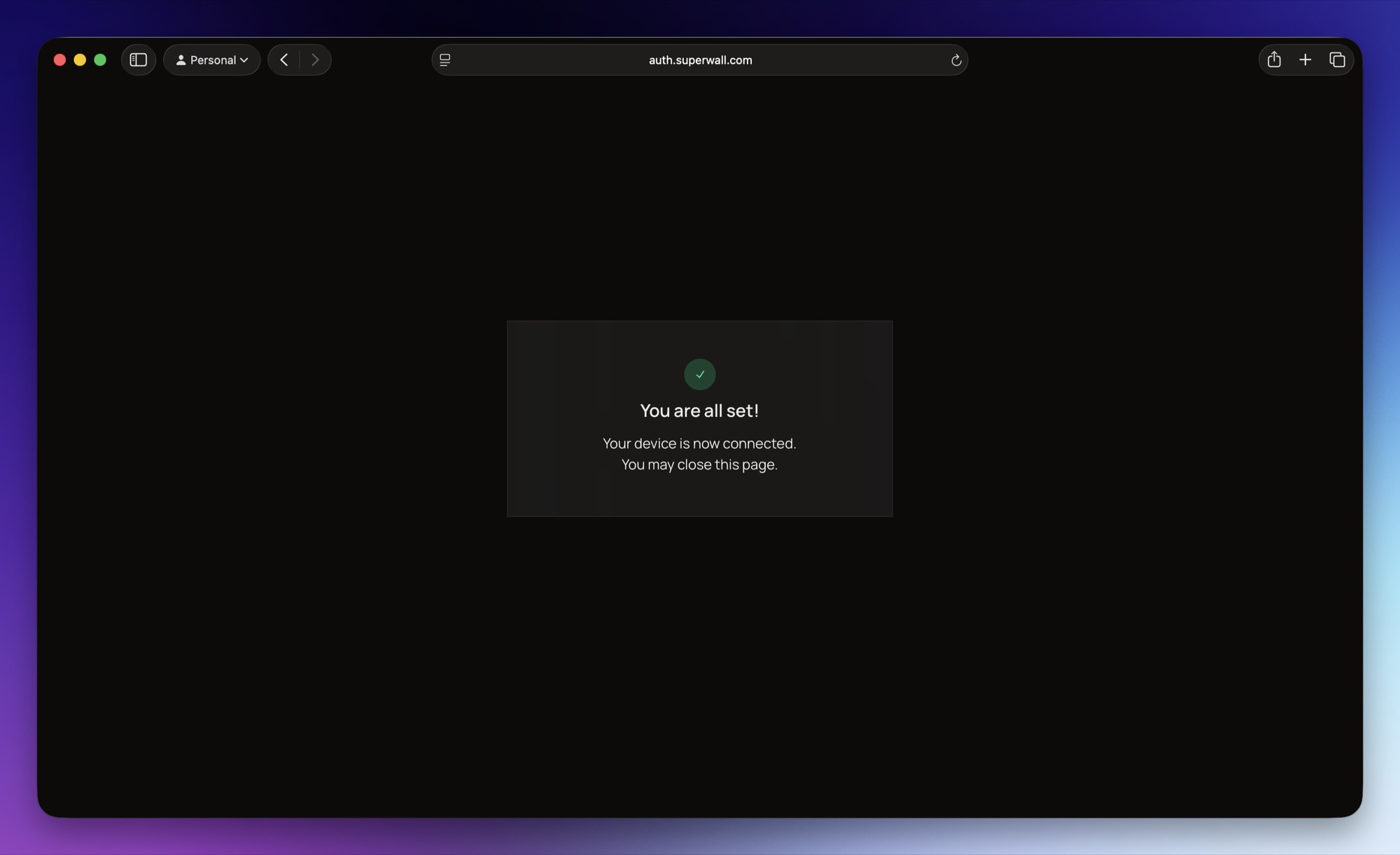
Approve the login on the page that opens, and you're done. The terminal picks it up automatically:
In CI or other headless environments, log in with an API key instead of a browser:
superwall login --api-key <key>If your account belongs to more than one organization, pick one with superwall orgs use. Otherwise, the CLI asks the first time it matters.
Logging in also installs the Superwall agent skills into your coding agents and keeps them updated. See Install agent skills below.
Set up your app
The CLI's workflow commands handle SDK setup end to end:
npx superwall integrate   # set up Superwall in your app from scratch
superwall migrate         # switch from RevenueCat, Adapty, or Qonversion
superwall review          # audit an existing setup; add --fix to repair issues
superwall doctor          # quick health check
integrate is the fastest way to get started, and it works even before you have a Superwall account: run it in your project directory and it walks you through signing up right from the terminal. It works out what kind of app it's looking at, connects it to your Superwall account, and then runs the coding agent already on your machine (Claude Code or Codex, headless) to install and configure the SDK. From there it walks you through the rest: products, campaigns, placements, paywalls, and verifying everything on a real device.
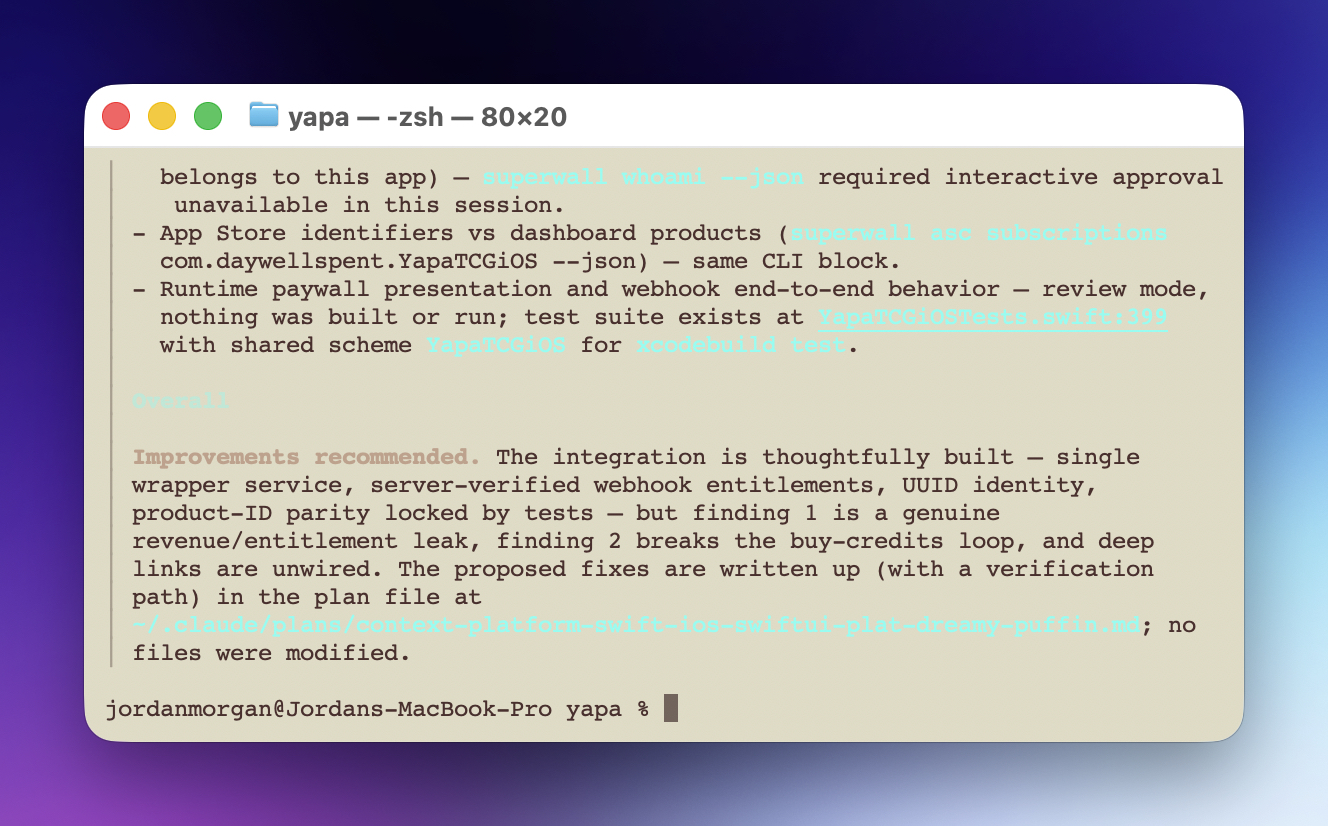
migrate does the same for apps moving off RevenueCat, Adapty, or Qonversion, and review audits an existing integration, with --fix applying verified, safe fixes. Here's the end of a review run against a real iOS app: findings ranked by severity, proposed fixes written to a plan file, and nothing modified without your say-so:
Drive the agent yourself
The CLI normally runs its workflows through a headless Claude Code or Codex on your machine. Add --skill to integrate, migrate, or review and instead of running anything, the CLI prints the exact instructions it would have given that agent: the bundled playbook for the task, composed for your project's framework, so an Expo project gets Expo instructions and never sees Swift ones.
superwall integrate --skill # prints the playbook, runs nothingReach for this when:
- You use a different agent. The CLI only drives Claude Code and Codex headlessly. Paste the playbook into Cursor, Gemini CLI, or any other agent and it can follow the same guided workflow there.
- You want to stay in the loop. A headless run works autonomously and reports back. Running the playbook in your own agent session lets you watch every step, approve each change, and steer as it goes.
- You want to read it first. Review exactly what the agent will be told to do before anything touches your codebase.
Manage your account
Everything in the dashboard, from the terminal:
superwall apps list
superwall products create pro_monthly --price 9.99 --period month
superwall products storekit               # generate a local .storekit file
superwall entitlements create pro
superwall campaigns create "Onboarding upsell" onboarding_complete
superwall paywalls list
superwall bootstrap # the whole account tree at a glance| Command | Actions | Notes |
|---|---|---|
bootstrap | Prints the complete account tree: orgs, projects, apps, campaigns, placements, and products | |
apps | list, create, use | Projects and platform apps; create takes --platform and --bundle |
products | list, create, storekit | create takes --price, --currency, --period, --period-count, --trial-days, --entitlement; storekit writes a local .storekit file (--out) |
entitlements | list, create | |
campaigns | list, create, placement | create takes a name and a placement name |
paywalls | list | |
orgs | list, use | Only needed if you belong to multiple organizations |
list is the default action, so superwall products means superwall products list. Add --json for machine-readable output, and --project <id> or --app <id> to scope when you have more than one. Run superwall <command> --help for every action and flag.
Query your analytics data
Run SQL directly against your organization's ClickHouse analytics data:
superwall query "SHOW TABLES FROM sw"
superwall query "SELECT count() FROM sw.events_rep"
superwall query --file mrr.sql       # runs a saved .sql file
cat query.sql | superwall query      # or pipe SQL on stdin
Use it for anything you'd build on raw data: ad hoc analysis, custom dashboards, scheduled reports, agent workflows. --json returns ClickHouse's native JSON envelope (leave any FORMAT clause out of the SQL; the CLI requests JSON for you). Your session needs data read access.
See Query with ClickHouse for the available tables and schema.
Call the API
Make raw, authenticated requests to any Superwall API endpoint:
superwall get /v2/products
superwall post /v2/products -d name="Pro Monthly" -d price:=9.99
superwall delete /v2/products/prod_123
Params follow an httpie-style convention: -d key=value sends a string, key:=value sends typed JSON (numbers, booleans, objects), and key[sub]=value nests. On get and delete, -d params become query parameters.
App Store Connect
The entire App Store Connect API, proxied and signed by Superwall, with no .p8 file or JWT to manage locally. Connect your credentials once:
superwall asc keys set --key-id <id> --issuer <id> --key-file AuthKey.p8From there, you can call any endpoint in the ASC API. The CLI is schema-aware: it keeps a copy of Apple's own OpenAPI spec (fetched on first use, refreshed in the background) and knows every endpoint, field, and enum.
Look up the exact schema for anything, without hunting through Apple's docs:
superwall asc docs                          # browse every resource
superwall asc docs "introductory offer"     # search by keyword
superwall asc docs /v1/subscriptions post   # required fields, enums, relationships
Write with flat params. The CLI assembles the JSON
body for you and validates it locally, so a mistake comes back as a precise fix instead of one of Apple's opaque409 errors:
superwall asc post /v1/subscriptions \
  -d name="Premium Monthly" -d productId=com.acme.pro \
  -d subscriptionPeriod=MONTHLY -d group=<groupId>
✗ Invalid POST /v1/subscriptions body:
• subscriptionPeriod "MONTHLY" not allowed — use ONE_WEEK|ONE_MONTH|…|ONE_YEARFix the value and it goes through. Shortcuts cover the common reads (asc apps, asc products <bundle-id>, asc subscriptions <bundle-id>, asc iaps <bundle-id>); everything else is asc get|post|patch|delete /v1/.... If your organization has more than one ASC team connected, scope with --team <id>.
Apple Search Ads
The entire Apple Ads Campaign Management API (v5), proxied by Superwall, with no client secret, OAuth token, or org id to manage locally. The CLI uses the credentials you connect in the dashboard (open the app → Integrations → Apple Search Ads → Advanced) and finds the connected app on its own, or takes --app <id>.
superwall asa campaigns list
superwall asa campaigns find --field status --op EQUALS --values ENABLED --all
superwall asa keywords create --campaign 123 --adgroup 456 \
  --text "grammar checker" --match-type EXACT --bid 1.25
superwall asa reports campaigns --start 2025-01-01 --end 2025-01-31 --group-by countryOrRegion
Every resource follows the same shape, asa <resource> <action> [id], scoped with --campaign, --adgroup, or --adam-id. The catalog is the documentation:
superwall asa docs                          # every endpoint, grouped
superwall asa docs keywords                 # one resource: usage, flags, Apple links
superwall asa docs campaigns create         # Apple's own page: fields, enums, examples
Writes take typed flags (money flags pick up the account's currency), -d key=value for any other field, or --body for the whole payload. Anything not covered is asa get|post|put|delete /path, sent straight to Apple with your access token and org context attached.
Install agent skills
Logging in installs the Superwall agent skills into your coding agents automatically and keeps them updated. To reinstall them (or a subset) manually:
npx superwall skillsThe CLI shows a picker with every skill pre-selected, so pressing Enter installs them all, globally, for every coding agent detected on your machine (Claude Code, Cursor, Codex, Gemini CLI, Copilot, Windsurf, and more). To skip the picker or force a refresh:
superwall skills --skill superwall        # install specific skills by name
superwall skills --force                  # reinstall even if already up to date
For agents and scripts
Pass --json to any command: stable output shape, structured errors, and it never prompts. --no-interactive keeps the human-readable output but drops the prompts.
superwall products list --json
superwall query "SELECT count() FROM sw.events_rep" --json
Feedback
Something broken, confusing, or missing? Send feedback straight to the team:
superwall feedback "migrate crashed on Expo"Telemetry
The CLI sends fully anonymous usage events (which workflow ran and whether it succeeded, never emails, IDs, file paths, SQL, prompts, or error messages). Opt out with SUPERWALL_TELEMETRY_DISABLED=1 or DO_NOT_TRACK=1.
Related
- Superwall Skill: Give your coding agent live Superwall docs and this CLI.
- Superwall MCP: Manage your account from MCP-compatible AI tools.
- Query with ClickHouse: The analytics tables behind
superwall query. - Editor MCP: Connect an agent to the paywall open in your editor.
- Vibe Coding: All the AI tools available for working with Superwall in one place.
How is this guide?
Superwall Skill
Give AI coding agents up-to-date Superwall docs, authenticated API access, and hands-on control of the paywall editor using the Superwall Skills.
Superwall MCP
Manage Superwall projects, paywalls, campaigns, products, and more from AI tools like Claude Code and Cursor using the Superwall MCP.