
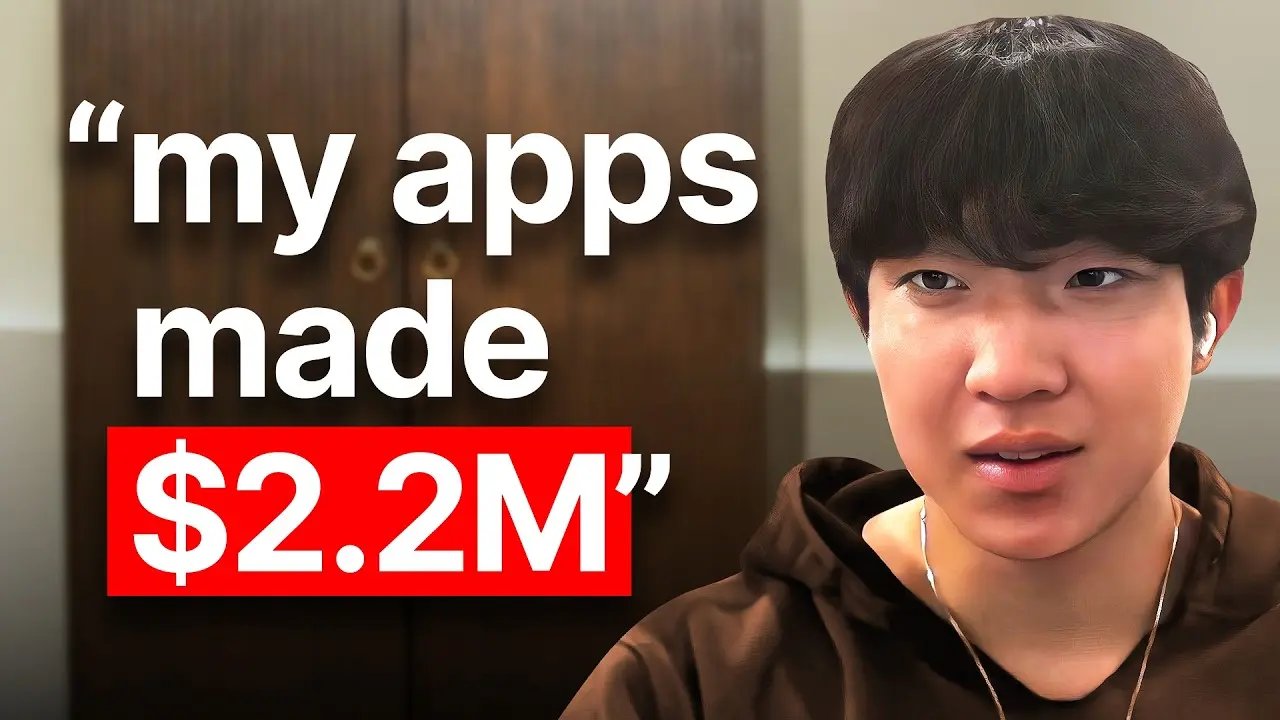

How Dan Built $2.2M in Revenue From Simple Apps (No-Code Style)
Building a consumer app to seven figures isn't something most founders pull off, especially not multiple times. Most struggle to get past their first thousand downloads, burn cash on ads that don't convert, or worse—build something nobody wants. But Dan Kwon cracked the code on turning cultural movements into million-dollar businesses, going from college influencer to serial app builder with hits like Kunch AI (which hit $500K revenue from one viral video), anime fitness apps generating $50K/month, and most recently, a Duolingo-style Bible study app that reached $75K MRR in 14 days.
In today's podcast interview recap, we'll break down Dan's exact playbook. He's obsessive about spotting cultural waves before they peak, creating content that feels authentic while driving massive conversions, and what he calls "Frankensteining" viral videos to build movements.
Our host, Joseph, covered a ton of ground with Dan. As always, if you haven't seen the interview yet, definitely check that out right here. For now, on to the recap:
The video that hit $500K in one month
Dan's breakthrough came from a single video. Not just any video—one that generated over 150 million views and drove half a million dollars in revenue in 30 days for Kunch AI, an AI detection bypass tool.
But here's the thing: Dan knew it would hit before it even took off. "I made the video, posted it, and 30 minutes later, I looked over at my co-founder and said, 'That's it. That video is going to hit at least 10 million views,'" he recalled. By the end of that day, the TikTok alone was at 15-16 million views. Then it started getting reposted on X by random accounts, snowballing to over 100 million views across platforms.
The format was deceptively simple. He found a low-quality video of a kid getting caught using AI in class—complete with a teacher yelling. Then he found different audio of a professor saying "No ChatGPT on this test." He merged them together. That's it.
"The sound of the teacher yelling at the kid worked so well with this other video overlay," Dan explained. The result was content that felt so authentic, viewers thought they were watching a real Snapchat story from a friend. It didn't look polished. It looked real.
The caption? "How the f is this kid acing every exam?" Zoom in, show the product. Pure hook and demo. Zero fluff.
That one video generated 220 million lifetime views and $2.2 million in revenue for Kunch. "In about 30 days, we hit a million ARR," Dan said. Then his school threatened to sue them.
Building movements, not just products
What made that Kunch video work wasn't just the format—it was the movement behind it. Dan tapped into something every college student felt: the frustration of busywork that doesn't lead to real-world skills or jobs.
"We were leaning into the emotion that I myself as a student felt at the time," Dan explained. "Students are assigned so much busywork during school and none of that really led to a good job. We're seeing that right now with how many 16-24 year olds are unemployed."
This is classic "us versus them" positioning. Students versus the system. ChatGPT users versus outdated professors clinging to AI detection tools. When you tap into that kind of collective frustration, you're not just selling a product—you're leading a movement.
"Humans love to gossip, humans love taking sides," Dan noted. "Anything that's going viral online is often outraging one group." His strategy? Lean into the outrage, become the voice for the angry crowd, and make your product the solution they rally behind.
This worked so well that even after Kunch sold (for an undisclosed amount), the movement continues. New startups building AI detection bypasses are still going viral with billions of views, proving the cultural frustration hasn't gone anywhere.
The art of "Frankensteining" viral content
Dan has a term for his content strategy: Frankensteining. It's not about making original videos from scratch—it's about finding what's already working and stitching pieces together to create something that feels both familiar and new.
For the Kunch video, he didn't shoot anything original. He found a video with 10,000 likes of a kid getting caught in class. Then he found different audio of a professor warning against ChatGPT. He married them together with Snapchat-style captions.
"The whole goal with the best UGC content is to lean into one extreme," Dan explained. "Either the cringe factor is super high and it feels so much like an ad that it feels like one of your friends from high school made it, or we lean so far into 'this video feels so real' that it's just something I saw in my Snap story."
The key insight? Lower quality often works better. "Subconsciously, you kind of recognize the lower frame rate and the lower pixelation from seeing Snap videos or Snap stories," he said. When something looks too polished, people's guard goes up. When it looks like it was shot on a phone in 30 seconds, they engage.
This strategy carried over to every subsequent project. For his Bible study app Shepherd, he didn't create elaborate original content. He found podcast clips of big Christian influencers like Bryce Crawford, added his own hook, and stitched them together. Seven videos. 20 million views. 100,000 downloads. $75K MRR in two weeks.
"I call it Frankensteining," Dan said. "You basically just find videos that have already gone viral related to your subject matter and you stitch them together."
The TikTok Shop playbook that prints money
After Kunch, Dan dove into TikTok Shop and e-commerce, eventually helping brands like Final Boss Sour hit #1 in their category. His approach? The exact same scrappy content philosophy.
"The scrappy style content that we saw work well with Kunch actually worked even better with TikTok Shop brands," he explained. The best-performing videos looked like they were shot in the founder's kitchen. No fancy lighting. No production crew. Just raw, authentic founder-led content.
One video Dan made for Final Boss Sour followed a simple formula: "We made way too much sour candy so we're putting it on sale. Not the typical junk you see filled with sugar and chemicals, but real fruit covered in real sour."
The angle? Small business struggling with inventory. Urgent clearance sale. High-quality ingredients. All delivered in a super casual, almost apologetic tone. "This video has been rinsed and repeated by all the UGC creators we brought on," Dan said. Every time, it hit.
The key to TikTok Shop success isn't just views—it's conversion. Dan learned that the hard way when early Final Boss content got tons of views but didn't convert. "You really have to nail content that not only goes viral, but more so converts," he explained.
His formula? Lean into the "small business factor" combined with limited-time offers. When Keith Lee (a massive food reviewer) covered Final Boss Sour, Dan immediately capitalized by making videos that referenced the review, layered in the small business narrative, and emphasized flash sales. The brand went nuclear.
Riding momentum waves (and knowing when to pivot)
One pattern in Dan's success: he doesn't try to create trends from scratch. He finds momentum waves that already exist and rides them.
Take Arise, his anime fitness app. He noticed fans of the anime "Solo Leveling" were posting on social media about wanting "the system" (the anime's gamified leveling mechanic) to exist in real life. "Everyone already wanted an app," Dan said. "There were already a couple out but none of them were optimized."
He built Arise in weeks, partnered with influencers in the anime space, and scaled it to $50K/month at 70-80% margins. The secret? He wasn't building a fitness app—he was building a tool for an existing cult of fans who desperately wanted to level up IRL.
Same story with Shepherd, his Bible study app. "The Christian community has been gaining a lot of momentum and we're seeing revival in Christianity right now," Dan noted. He and his co-founder wanted to build something "purpose-driven," and both struggled with consistent Bible reading growing up.
So they built a Tamagotchi-style app for Bible study. You take care of a lamb (representing your soul) by reading daily devotionals. It launched with seven videos, hit 20 million views in two weeks, and reached $75K MRR.
"It was a two-week build alongside a two-week growth sprint," Dan explained. Nothing was optimized. The app broke constantly. But the movement was there, so the product grew anyway.
The lesson? Don't try to manufacture demand. Find where the demand already exists, then build the tool that serves it.
Founder-led content beats everything
If there's one hill Dan will die on, it's this: founders need to be the biggest advocates for their own products. No exceptions.
"If you're a founder and you're scared to do any sort of founder marketing, then you shouldn't be building your app," he said bluntly. "It's almost to that degree."
The content doesn't need high production value. You don't need to be a professional editor. You just need to genuinely care about your product and understand your ideal customer profile. "Gen Z, Gen Alpha goes off of vibes," Dan explained. "It's not about all the little tips and tricks."
For Final Boss Sour, even though it was a VC-backed company making millions monthly, the best-performing content looked like it was shot in the founder's bedroom. Same with Shepherd—Dan's face was front and center in the viral videos, not some hired creator.
"The founder should be the biggest influencer in a sense," he said. "You should be willing to make the most content for your app, at least in terms of cold starts."
This authentic, founder-led approach builds trust faster than any polished ad campaign. When people see the person behind the product talking passionately about it, they buy into the vision, not just the features.
The influencer strategy that scales to $75K MRR
When it came time to scale beyond his own content, Dan had a clear playbook for working with creators.
For Arise (the anime fitness app), he targeted micro and mid-tier influencers—not mega creators. "Most of the influencers and meme pages we worked with were happy with a $1-2 CPM," Dan said. Meanwhile, the app was generating around $6-7 RPM, making the economics work beautifully.
The key was finding creators who were already embedded in the niche. Anime meme pages. Fitness influencers who loved Solo Leveling. They understood the audience and could speak authentically without heavy creative direction.
For Shepherd, the strategy was even scrappier. Dan found viral podcast clips of Christian influencers, added his own hooks, and reposted them. "I call it Frankensteining," he repeated. "You basically just find videos that have already gone viral related to your subject matter and you stitch them together."
Seven videos. 20 million views. $75K MRR. No massive influencer budget required.
The framework works because Dan wasn't trying to buy reach—he was amplifying content that already resonated. Then, once he had proof of concept, he could bring on more creators to scale the formats that worked.
When AI coding tools meet scrappy marketing
One underrated part of Dan's success? Modern AI coding tools let him ship products fast. Shepherd went from concept to App Store in two weeks. Arise wasn't much longer. Kunch was built in a single night (the Figma prototype, at least).
"We're in the AI bubble. It's very similar to the dot-com bubble," Dan said. "Apps are so easy to build now. Once you have all the systems in place for UGC and influencer programs, it doesn't take too much overhead."
This is the no-code (or low-code) revolution in action. Dan doesn't need to be a technical genius. He just needs to be fast, scrappy, and willing to launch before everything's perfect.
"The app broke a ton. There were a lot of issues," he admitted about Shepherd's launch. "But we got it to $75K MRR in those two weeks." They refined the product after proving demand, not before.
The mindset shift here is massive. Most founders spend months perfecting their MVP before launching. Dan launches in weeks, proves demand with viral content, then iterates based on real user feedback.
The hard truth about hard paywalls
Dan's philosophy on monetization is controversial but dead simple: if you need a hard paywall, your product probably isn't good enough.
"Apps that are actually useful and helpful, like Strava, give you a free trial and you get entrenched," he explained. "Eventually you have this emotional trigger where it's like, 'I probably should pay for Strava Premium.'"
Hard paywalls, in his view, are compensation for products that don't have real retention hooks. "You lose the ability to actually build an app that people stay on. Without that, you can't do a premium model," he said.
His framework? Create an external trigger (what gets users to open the app), a simple action (what they do inside), a variable reward (the dopamine hit), and over time, build investment through data and personalization.
"The easiest path to 100K downloads: trigger, action, variable reward," Dan said. "If you want to go bigger and build a retentive app people keep coming back to, you need to figure out the investment part."
For Shepherd, that meant shifting focus from viral UGC to social loops—encouraging users to invite "prayer buddies" for accountability. That's the investment layer. That's what turns downloads into retention.
What's next (and what you can learn)
Dan's still hacking away nights and weekends on new projects. He's not satisfied with one-hit wonders—he's chasing something he can work on for years, not months.
But if you're building an app right now, here's his advice:
Post about your product constantly. Don't overthink formats. Just share it on TikTok and Instagram. Gather data on what works, then double down.
Look up phrases related to your niche. Find videos already going viral, then stitch or respond to them. Start conversations with the community you're building for.
Work with influencers smartly. Target creators with 50K-250K followers who are hungry for deals. Aim for $1-2 CPM. Convert them into full-time UGC creators if they perform well.
Don't touch paid ads until you've cracked five winning organic formats. Paid is expensive and low-ROI early on. Nail organic first.
Become your ICP. "I always get into the shoes of the ideal customer profile," Dan said. "I become the ideal customer profile." If you can't empathize deeply with your users, your content and product will fall flat.
Wrapping up
Dan Kwon's success isn't about one lucky viral video. It's about systematically spotting cultural movements, building products that serve them, and creating scrappy, authentic content that resonates.
From Kunch AI's $2.2M run to Shepherd's $75K MRR in 14 days, the pattern is consistent: find the wave, build fast, market authentically, and iterate based on real feedback.
"You can make any product go viral," Dan said. "It's more a matter of conversions and retention." The viral moment is just the beginning. What separates flashes in the pan from sustainable businesses is whether you can turn that initial surge into lasting engagement.
The tactics change. The cultural movements shift. But the fundamentals stay the same: build something people actually want, speak their language authentically, and don't be afraid to be scrappy.
As always, if you're ready to test your paywall, run price tests and more for your app, then you're already in the right spot. Sign up for a free Superwall account today!