
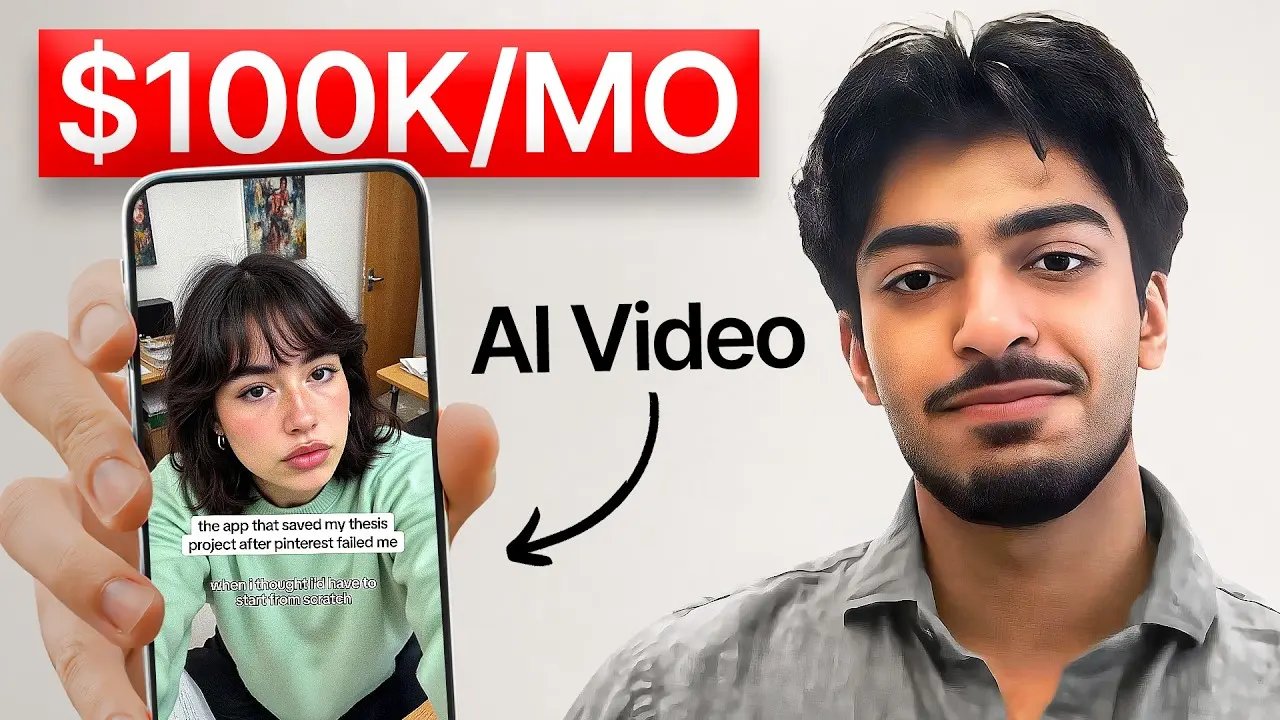

Recently on our YouTube channel, Joseph sat down with Zuhair Lakhani, who's built what might be the most sophisticated AI content operation in the game. His startup has clients generating 4.7 million views in less than 4 weeks with just 15 accounts. He hit $100k in revenue in a single month using completely AI-generated TikTok content. And he's raised $1M from A16Z to scale it all.
But here's what's interesting — this didn't start with tech. Zuhair got his start in sneaker botting during COVID, then brought Supreme-style hype tactics to restaurant marketing, and eventually cracked the code on making AI content at scale. What he's built is a complete system: physical phone farms that warm up hundreds of TikTok accounts, AI that generates winning content formats, and a feedback loop that makes videos more viral over time.
From sneakers to startups
Zuhair started in sneaker botting like many young entrepreneurs. But he quickly realized sneakers weren't liquid enough — even a good Yeezy flip meant listing each pair individually and waiting for sales.
So he pivoted to retail botting during COVID. Regular consumer goods that go out of stock: printers, tools, baby toys. He sold hundreds of Coco Melon dolls. It was pure arbitrage — finding inefficiencies in supply and demand and exploiting them before anyone else could.
Then he got into white labeling his own products. He designed pickleball paddles that ended up in TJ Maxx. The retail space taught him logistics and manufacturing, but the real education came from his dad's restaurant.
That's where he learned about hype marketing.
The restaurant waitlist strategy
Zuhair's dad opened a restaurant, and Zuhair ran the marketing. He'd only seen this kind of marketing from sneaker bots and Yeezy launches — so he replicated Supreme's tactics for reservations.
He created a waitlist. Not because they needed one initially, but because controlling scarcity creates demand. When the first reservation drop happened, only 20 people signed up. They had space for 100.
He said it was done anyway.
Better to look full and have people begging for a spot than to look empty. The waitlist grew to 6,000 people. The restaurant was sold out for 2 months straight. They even got press coverage just because nobody could get in.
They dropped reservations every Wednesday at 4pm — exactly like a sneaker drop. Random 50-year-olds on Facebook were confused, but everyone wanted in. That artificial scarcity, paired with genuine word-of-mouth from people posting reviews, created momentum that money couldn't buy.
The TikTok shop breakthrough
After the restaurant, Zuhair took a break and joined a crypto startup during the zero-interest-rate period. It didn't go anywhere, but it was his first look into scalable tech.
Then he connected with Jimmy Farley (big in the TikTok marketing space) and started making content for brands. The videos did well. And he realized — if I'm making someone else money doing this, I can probably do it for myself.
He took a poster design he'd made for a client who didn't use it, put it on a mockup, and listed it on TikTok Shop. He made one video using AI: Eleven Labs plus Midjourney.
Day one: 5K views, three sales.
That was enough validation. He went to a print shop, gave them $100 deposit, and said "as soon as I call, just print my posters."
He scaled the content using AI-generated slideshows. Every video followed a pattern: cool stuff you need in your room, featuring multiple products, with his poster subtly included as one of them.
The first month? $100k in TikTok Shop sales using completely AI content.
Then his 3PL manager got deported to Mexico on New Year's Eve weekend with 1,000 orders lined up. TikTok banned his account for missing the 2-day delivery deadline.
The 95/5 rule
Zuhair's philosophy on AI content is simple: "You want AI to do 95% of the work and then human comes in 5% for touch-up."
He's not selling the dream that AI can do everything. It can't. The last 5% — that human creativity, that subtle contextual adjustment — is what makes content actually convert.
This is where most people get it wrong. They either try to manually create everything (doesn't scale) or they let AI do 100% (loses authenticity and gets flagged).
The sweet spot is using AI for the heavy lifting while keeping humans in the loop for final quality checks and strategic tweaks.
Building the phone farm
The traditional way to run multi-account content strategies is hiring college kids. Pay them $500-1,000 per month to make 30 videos in 30 days.
But there's no accountability. Sometimes they post, sometimes they don't. Sometimes they follow guidelines, sometimes they don't. You need one person full-time just managing 25 creators in Slack or iMessage.
The ROI isn't there.
Zuhair tried using Android emulators in 2023. That worked for a while. But TikTok got smarter. They added device fingerprinting. Any social platform can easily detect emulators now.
So he built physical phone farms. Real devices running custom software that swipes on TikTok, reposts, comments, and mimics natural human behavior.
Every account lives on a real device. The software controls everything to look like an actual person using their phone. This bypasses TikTok's detection systems because, from their perspective, it is a real person.
The double speed platform
But phone farms are just the distribution layer. You still need good content.
That's where Double Speed comes in — Zuhair's VC-backed startup. It's a complete platform that handles:
Content creation using AI templates
Account warming and management
Scheduling and posting across real devices
Performance tracking with feedback loops
Here's how it works:
You start by telling the platform about your product. Say you're building an AI executive coach. You input: "helps you make better business decisions, targeting 20-44 year old males."
The system auto-generates account profiles with usernames, bios, and search terms. It even checks TikTok availability for usernames.
Then you pick from proven content templates. Maybe it's a "5 Spanish phrases" slideshow for a language app, or a hook-and-demo format for a productivity tool.
You can customize every element. Swap images from a public image bank, adjust the hook text, change backgrounds. The platform lets you generate multiple variants with one click.
Once your content is ready, it queues to real devices for posting. No manual work. No hiring college kids. No managing Slack channels.
The feedback loop
The real power is in what Zuhair calls "attention intelligence."
Every post generates data: views, likes, comments, shares. The system tracks all of it and feeds it back into the AI. Over time, the platform learns which formats work best, which hooks drive engagement, which images convert.
This isn't you manually feeding high-performing tweets into ChatGPT and asking it to analyze them. It's automated learning at scale.
One client got 4.7 million views in less than 4 weeks with just 15 accounts. That's about 313,000 views per account. The content keeps getting better because the system keeps learning.
Finding winning formats
So how do you actually find formats that work?
Zuhair's advice: search for terms related to your product. If you're building a study tool, look at "study hacks" or "productivity tips" on TikTok.
Find videos from the last month or two that went viral. Those are your templates.
His platform lets you drop in a TikTok link, and it generates a modular template you can customize. You're not copying content — you're extracting the format and adapting it.
For example, a slideshow might follow this pattern:
Hook: "I used to struggle with [problem]"
Clarify the problem with relatable imagery
Show 3-4 potential solutions (make them high-effort)
Introduce your app as the easier solution
End with a subtle CTA
The first slide is usually AI-generated. The rest pull from an image bank. This blend of AI and curated content feels authentic while being scalable.
The content strategy
Zuhair's approach to hooks is deliberate. Start by naming the pain point. Then show solutions — but make the first few solutions feel like too much work.
Nobody's going to buy a scale to weigh their meals every day. But they might download an app that tracks calories automatically.
By contrast, if you lead with your app as the only solution, it feels like an ad. But if you position it as one option among several (and the easiest option), it converts better.
This is the psychology of good content marketing: make your product the obvious choice without making it feel like you're forcing it.
Key takeaways
AI should do 95% of the work. Humans refine the last 5%.
Own the entire content stack. Creation, distribution, and analytics need to work together.
Use real devices for posting. Emulators and VPNs get flagged. Physical phones don't.
Find winning formats first. Test, validate, then automate.
Build feedback loops. Let performance data inform future content.
Borrow tactics across industries. Hype and scarcity work everywhere.
Focus on scalable systems. Don't just chase one-off viral hits.
Wrapping up
Zuhair's journey from sneaker botting to raising $1M for AI content infrastructure shows how quickly things are evolving. The traditional creator economy — hiring dozens of people to manually post content — is being disrupted by systems that blend AI efficiency with human creativity.
The arbitrage right now is in execution. Anyone can access AI tools, but few people have figured out how to systemize content creation at scale while maintaining quality and avoiding platform detection.
As always, keep it locked to our YouTube channel to catch the next interview. If reading is more your speed, I'll always recap the episodes here too. And if you're new to Superwall, go grab a free account and start growing your app today.