What actually saves subscribers on Apple's cancel screen? First benchmarks from 30 apps
We looked at every retention message Superwall served in production over the last 30 days, across 30 iOS apps. The typical app saves 13 to 21% of subscribers who reach the cancel screen — and a plain, specific text message did as well as a discount.

Apple finally gave us a seat at the cancel screen. Now we have the first numbers on what happens there.
Since Apple opened the Retention Messaging API, every guide out there covers setup. Nobody has shared results. So we looked at every retention message Superwall served in production over the last 30 days, across 30 iOS apps.
How we measured
- Data: every retention message Superwall served in production in the last 30 days (Aug 31 to Sep 28, 2026). That's about 73,000 sends across 30 iOS apps.
- Message types: text message, promotional offer, and switch-plan. These are the three responses Apple lets you return.
- Save: the subscriber did not cancel within 24 hours of seeing the message. This is the same definition as the Save Rate chart in the Superwall dashboard.
- Median, not average: a few big apps drive most of the volume. So we calculate a save rate for each app, then take the median. It tells you what a typical app sees.
- Excluded: apps with fewer than 100 sends of a given type, and one app whose cancellation events don't reach Superwall.
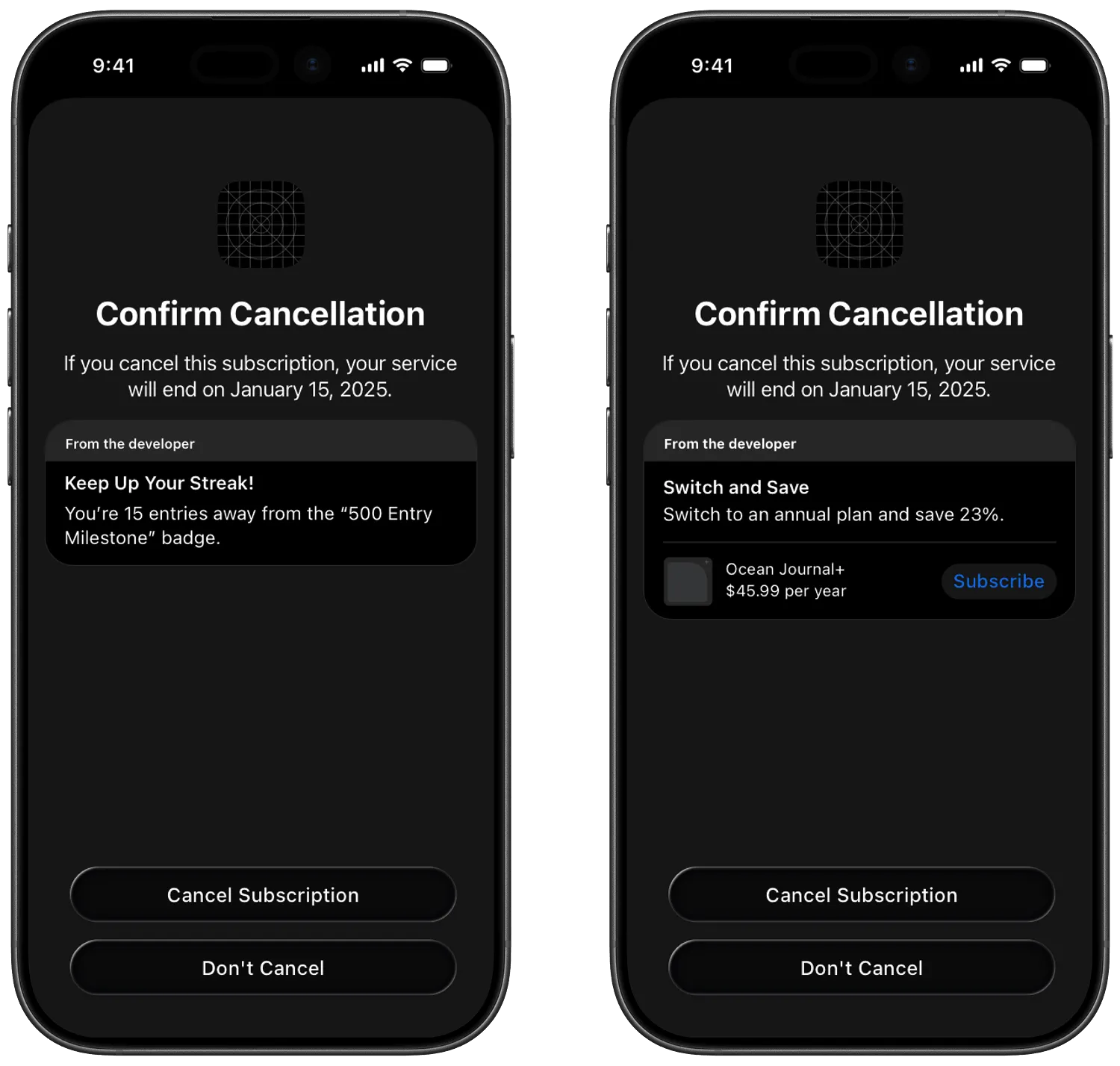
The benchmark
A typical app keeps 13 to 21% of people who reach the cancel screen, depending on the message type.
| Message type | Apps | Median save rate | Middle half of apps | Best app |
|---|---|---|---|---|
| Text message | 11 | 20.7% | 7 to 29% | 45% |
| Promotional offer | 11 | 17.7% | 10 to 23% | 30% |
| Switch-plan | 12 | 12.9% | 5 to 20% | 28% |
These numbers look low if you're used to paywall conversion rates. Remember who's on this screen: people who went into Settings to manage their subscription, and more than 80% of them cancel. Keeping 1 in 5 of them is a real win you'd otherwise never get.
What we learned
1. Discounts don't clearly beat a good message
We looked at eight apps that ran both a text message and a discount (promo or switch-plan). In six of them, the text message did as well or better.
| App | Text message | Discount |
|---|---|---|
| App A | 20.7% | 15.4% (promo) |
| App B | 22.0% | 20.4% (switch-plan) |
| App C | 15.0% | 13.4% (promo) |
| App D | 29.3% | 19.5% (switch-plan) |
| App E | 34.3% | 27.5% (switch-plan) |
| App F | 45.3% | 17.7% (promo), 14.4% (switch-plan) |
| App G | 26.1% | 29.8% (promo) |
| App H | 7.1% | 8.3% (promo) |
One caveat: the biggest gaps (Apps D, E and F) come from apps with only 100 to 150 text sends. Among apps with 300+ text sends, text still won in three of five. So it's not that text always wins. It's that discounts don't reliably win.
Which text works best? We grouped the text messages by angle. Naming exactly what people lose came out on top.
| Angle | Example | Apps | Median save rate |
|---|---|---|---|
| Concrete loss | "You'll lose your scans, scores and history" | 8 | 21% |
| Lost progress or streak | "Your streak ends here" | 1 | 29% |
| Personal goal reminder | "You wanted to work out more consistently" | 2 | 14% |
| Fear of missing out | "New content is added every week" | 1 | 7% |
- Be specific. The top messages named things the user built or owns: their scans, their library, their data. A generic "You'll lose access to the app" saved only 6%.
- Look back, not forward. Reminding people what they already have beat promising what's coming next.
- Make it personal. A goal reminder worked when it echoed the user's own goal, and fell flat as a generic pep talk.
Each message ran in a different app, so these are strong hints, not proof.
This doesn't mean discounts never work. It means you should earn the discount. Test a strong message first, then see if a promo beats it.
2. Switch-plan is mostly a nudge
Switch-plan had the lowest median save rate at 12.9%. And only about 1.4% of switch-plan sends ended in an actual plan change within 24 hours. Most of its saves are people who just didn't cancel.
If you use it, point people to a longer plan. Apps that offered weekly subscribers an annual plan saved 11 to 21%. Apps that offered monthly subscribers annual saved 5 to 18%.
3. Weekly subscribers are the hardest to keep
| Plan being cancelled | Apps | Median save rate |
|---|---|---|
| Annual | 19 | 16.3% |
| Monthly | 9 | 13.5% |
| Weekly | 8 | 12.6% |
Our guess: annual subscribers have more to lose, so a reminder lands better. Weekly subscribers often decided long before they got to Settings.
4. Most saves stick
We checked the same subscribers 7 days later. Text and promo saves hold up well: median save rates drop by only 1.5 to 3 points. Switch-plan drops from 11.6% to 7.9%, so about a third of those saves cancel within the week.
How to set yours up
Start simple, measure, then add discounts where they earn their place.
- Set a default message for every product and locale. Apple shows it whenever a real-time response fails. Locales don't carry over, so en-US won't cover en-GB.
- Write a loss-framed message first. You get 66 characters for the header and 144 for the body. Name the one thing people lose: progress, streaks, saved content, shared access.
- Match the offer to the plan. Apple only tells you the product and locale, so segment on those. Offer weekly and monthly subscribers a switch to annual. Keep promo offers for plans where price is the obvious reason people leave.
- Submit early. Every production message and image goes through Apple review, and it can take days.
- Rotate and compare. Run one message type per product for a couple of weeks, swap it, and compare save rates in the Superwall dashboard. We're also working on native A/B testing for retention messages, so you'll soon be able to run this comparison automatically instead of rotating manually.
What this data can't tell you (yet)
- Save rate isn't lift. Nobody runs a "no message" control, so some of these people would have stayed anyway.
- Apps chose their own message types. Text messages often run as the default fallback, so they reach different products and locales than offers do.
- It's early. 30 days of data and 30 apps. We'll update these numbers as more apps go live.
- "Sent" means we answered Apple. Apple doesn't confirm the message was shown on the device.
Try it on your app
Superwall hosts the Retention Messaging endpoint for you. No app update, no backend, and save rate reporting out of the box. You still need Apple to approve your app for the API first.
Set up Apple Retention Messaging →
What's working on your cancel screen? We'd love to hear.
FAQ
- What's a typical save rate for Apple's Retention Messaging API?
- Across 30 iOS apps and 73,000 sends over 30 days, the median app saves 13 to 21% of subscribers who reach the cancel screen, depending on message type. The best apps save 25 to 30%.
- Do discounts save more subscribers than a plain message?
- Not reliably. Across eight apps that ran both, a plain text message did as well as or better than a discount in six of them. Median save rate was 20.7% for text versus 17.7% for promotional offers. The strongest messages named exactly what the subscriber would lose.
- Why does switch-plan perform worse than text or promo?
- Switch-plan had the lowest median save rate (12.9%), and only about 1.4% of switch-plan sends actually resulted in a plan change within 24 hours — most of its 'saves' are people who simply didn't cancel. It works best when it offers weekly or monthly subscribers a switch to annual.
- Does Superwall support Apple's Retention Messaging API?
- Yes. Superwall hosts the Retention Messaging callback endpoint, message management, and save-rate reporting from the dashboard, with no app update or backend required. Your app still needs Apple's approval for the API first.