State of App Monetization 2026: How Apps Climb From $500 to $1M a Month
Twelve months of Superwall data from 9,770 revenue-earning apps: what changes at each revenue rung, and how much of it you can do on Monday.

I gave this talk at Superwall's Deadly Good Growth session at NY App Week, and you can watch the whole thing above. I run customer growth and product at Superwall, which means I work with about 50 of the top and fastest-growing apps on the App Store, watching what works and what doesn't. This post covers the same ground, with the slides.
The questions I get most are tactical: what's the best paywall design right now, what should I test next in onboarding, what are the big apps doing that I'm not. They're good questions. But the real question is bigger: how do I take my app from $500 a month to $10K, from $10K to $100K, and on up to $1M? So that's what this talk is about.
The ladder is climbable
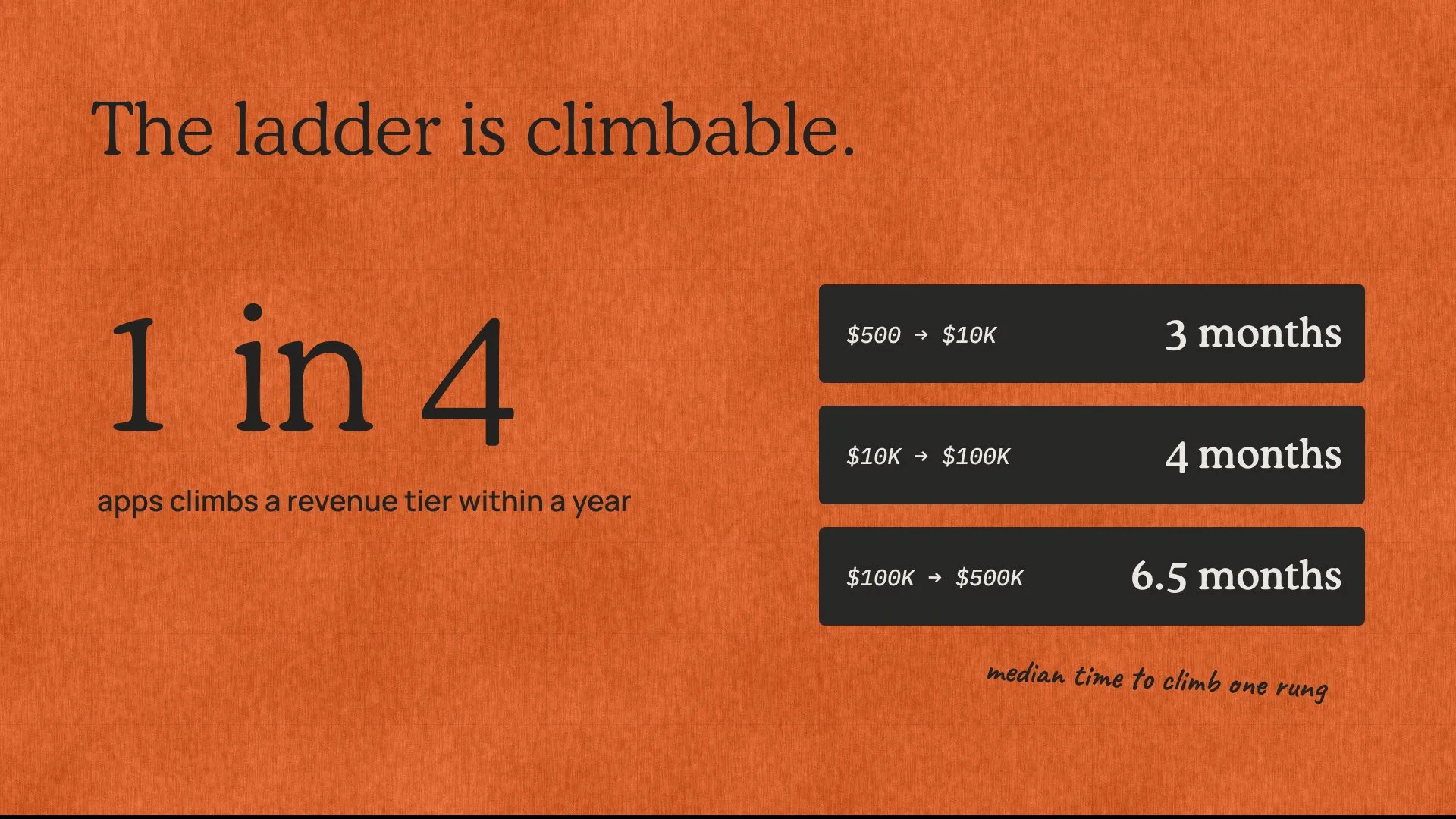
Across the last 12 months, about one in four apps climbed to the next revenue tier. The median time to climb one rung was 3 months from $500 to $10K a month, 4 months from $10K to $100K, and 6.5 months from $100K to $500K.
The apps that climb aren't luckier than the ones that stall. At each rung they do a short list of specific things, and that list is what the rest of this post is about. The data comes from 12 months of Superwall: 9,770 revenue-earning apps, 1.25 billion installs and 56 billion events.
The stage
People spent $117.6 billion in the App Store last year, more than double what they spent in 2019 and more than the GDP of Croatia, Luxembourg and about 120 other countries. That's 2.4 times Google Play's $49.2 billion, and it kept growing even as the App Store opened up to other payment providers.
For the same app on both platforms, an Android install earns 39 cents for every dollar an iOS install does: $0.52 in net proceeds per install against $1.46. The gap is everywhere, but it varies a lot by category. Dating comes closest, at 78 cents on the dollar. Photo and video is furthest apart, at 19 cents.
Where your app sits
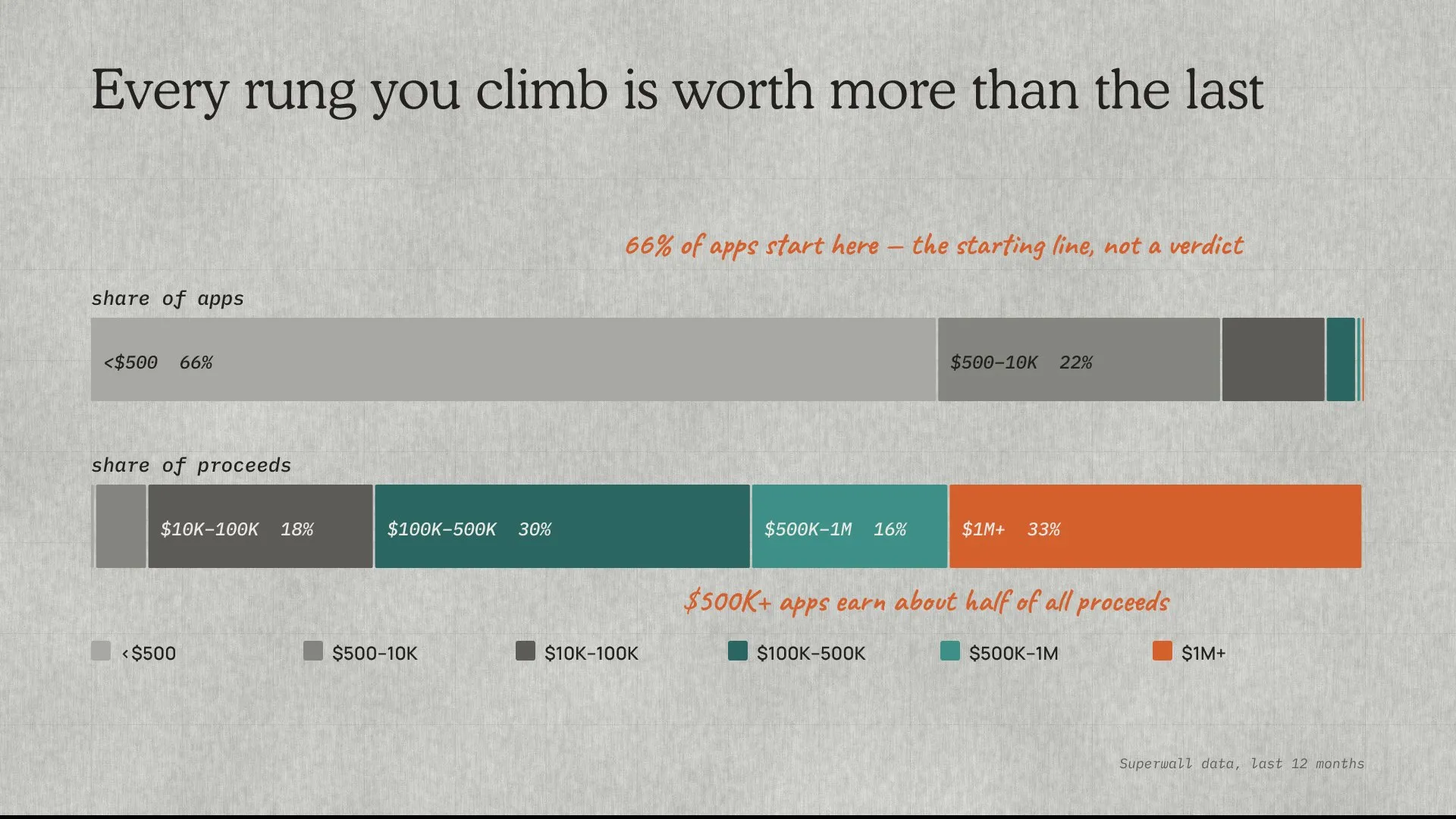
Most apps start at the bottom: 66% earn less than $500 a month. That's the starting line, not a verdict. And every rung you climb is worth more than the last. Apps earning $500K or more a month take about half of all proceeds.
Past $10K a month, the median app grew 16% to 38% last year. Below $500, the median app's proceeds fell 40%. That isn't the category shrinking. It's competition: far more apps launch, monetize and stall, because the founder shipped something rough, stopped investing, or moved on. If you've watched new apps pile onto your keywords this year, you've felt it.
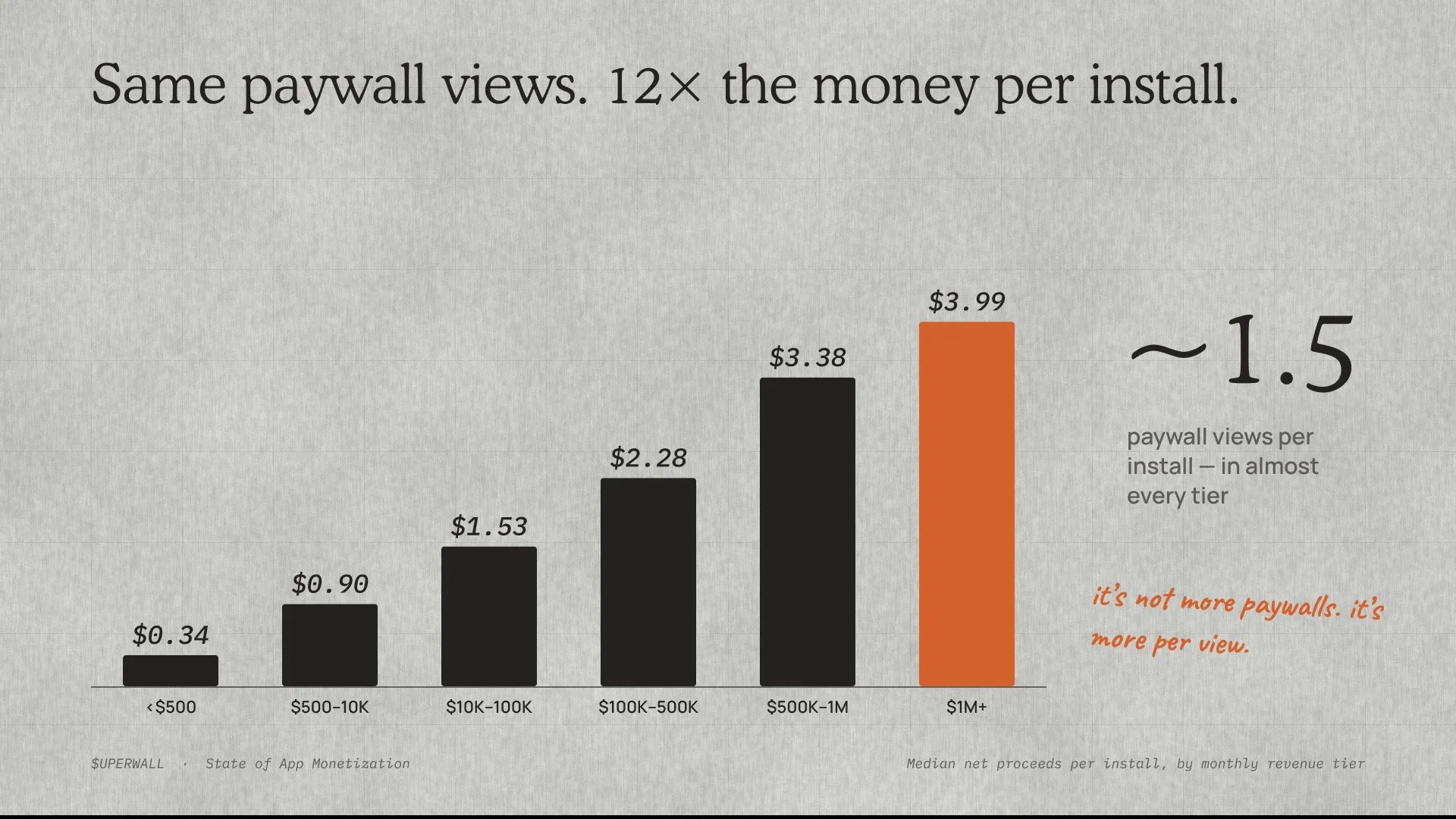
Here's the surprising part: the biggest apps don't show more paywalls. In almost every tier it's about 1.5 paywall views per install. They just make 12 times more per install than the apps at the bottom. It's not more paywalls. It's more per view.
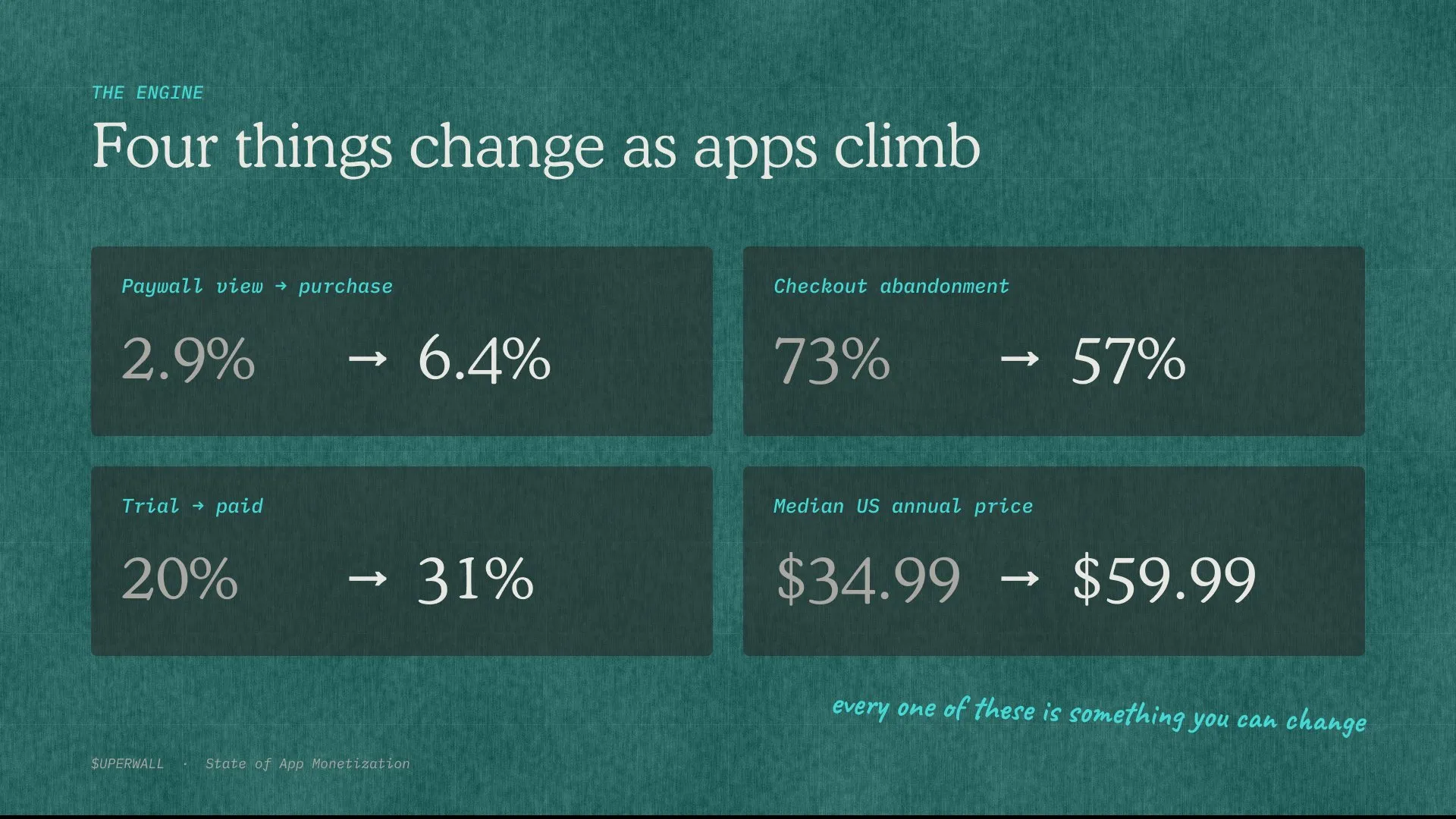
Four things change as apps climb. Paywall view to purchase more than doubles, from 2.9% to 6.4%. Checkout abandonment drops from 73% to 57%. Trial to paid goes from 20% to 31%. And the median US annual price goes from $34.99 to $59.99. Every one of these is something you can change.
For each tactic below, the rung shows where it's common, not when you're allowed to start. Some you can do now, because they're cheap and work at small tiers too. Some need volume, because you need the traffic to read the results. Some need maturity, because the product or brand has to be ready. And the $10K apps that already do the "big app" thing often win bigger.
Business model first
The question I get all the time is "should I use a hard or soft paywall?" It's the wrong first question. It's like buying a wedding ring before you've started dating someone.
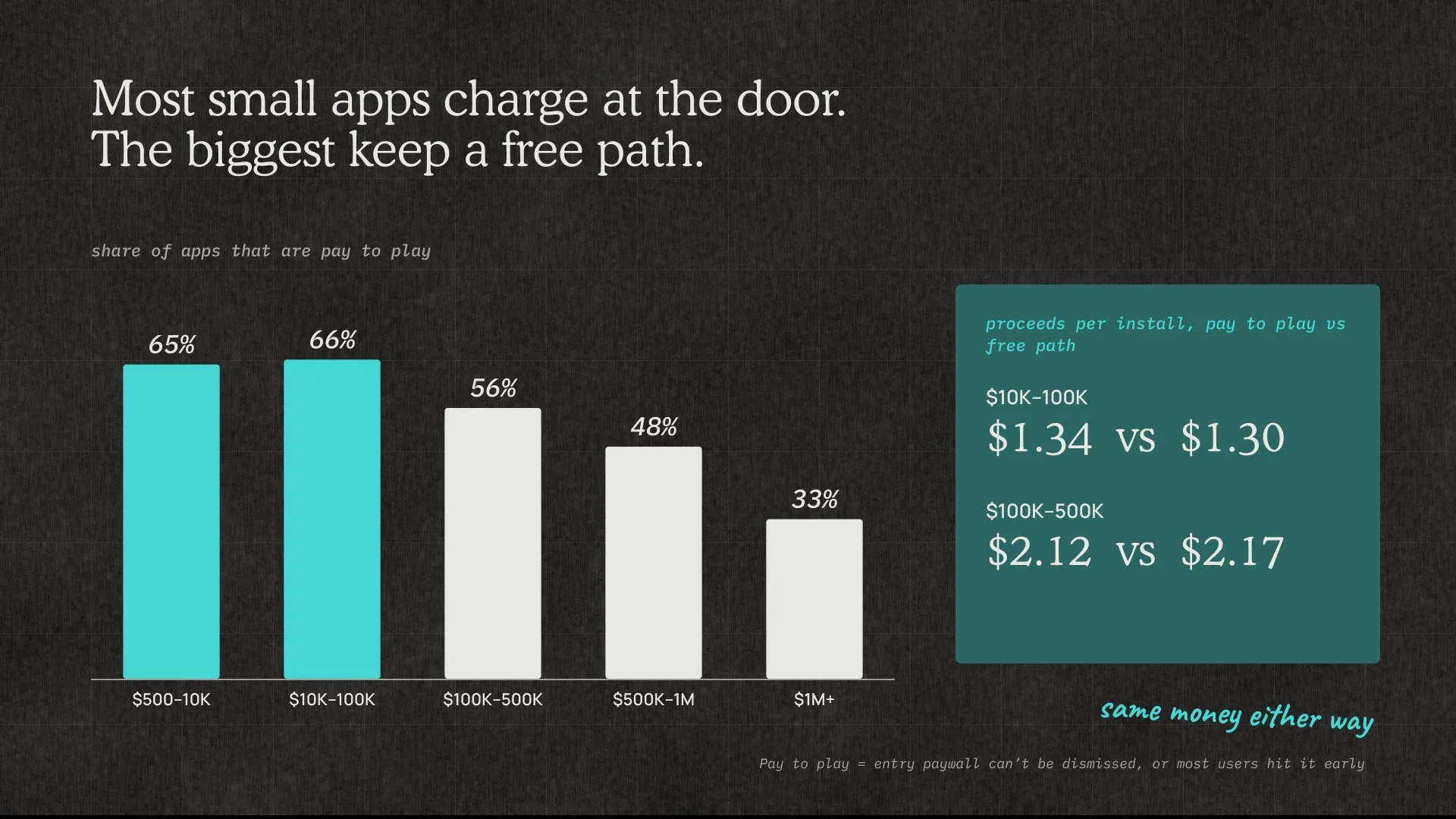
Most small apps charge at the door: about two thirds of apps under $100K a month are pay to play, meaning a paywall you can't dismiss, or one most users hit early. I count reverse trials here too, like letting people do three workouts before you gate the core product. The biggest apps keep a free path: only a third of $1M+ apps are pay to play. Part of that is age, since older apps grew up when freemium was the default. And the money is about the same either way: $1.34 against $1.30 per install at $10K–$100K, and $2.12 against $2.17 at $100K–$500K.
So before you pick a paywall, answer these:
- Is there a clear product-led path to upgrading?
- Do free users add network value to the product?
- Do free users bring word of mouth or referrals?
- Is there inherent value in having free users?
- How much do free users cost to operate?
- Will free users feed paid users downstream?
- Do free users distract from building for payers?
- Does the product need a critical mass of users?
Too often I talk to developers who added a free tier, get nothing from their free users, and want to move to a hard paywall. Their free users don't make the app better, there are no referral loops, and nobody thought about how to upgrade them. Have conviction, even without data.
$500 to $10K: leave the defaults
Four things change as apps cross $10K a month:
- Apps offering a free trial go from 58% to 77%.
- The median number of products sold goes from one to three, so users choose between intervals and intro offers.
- Sales through Superwall's default campaign trigger fall from 19% to 10%, because apps start choosing where in the experience to show a paywall.
- Tests per app per year go from 1.4 to 4.9.
You don't have to wait for any of these. Free trials are the clear first step: adoption climbs with every tier and tops out around $10K. Paid intro offers climb too, and we'll come back to them.
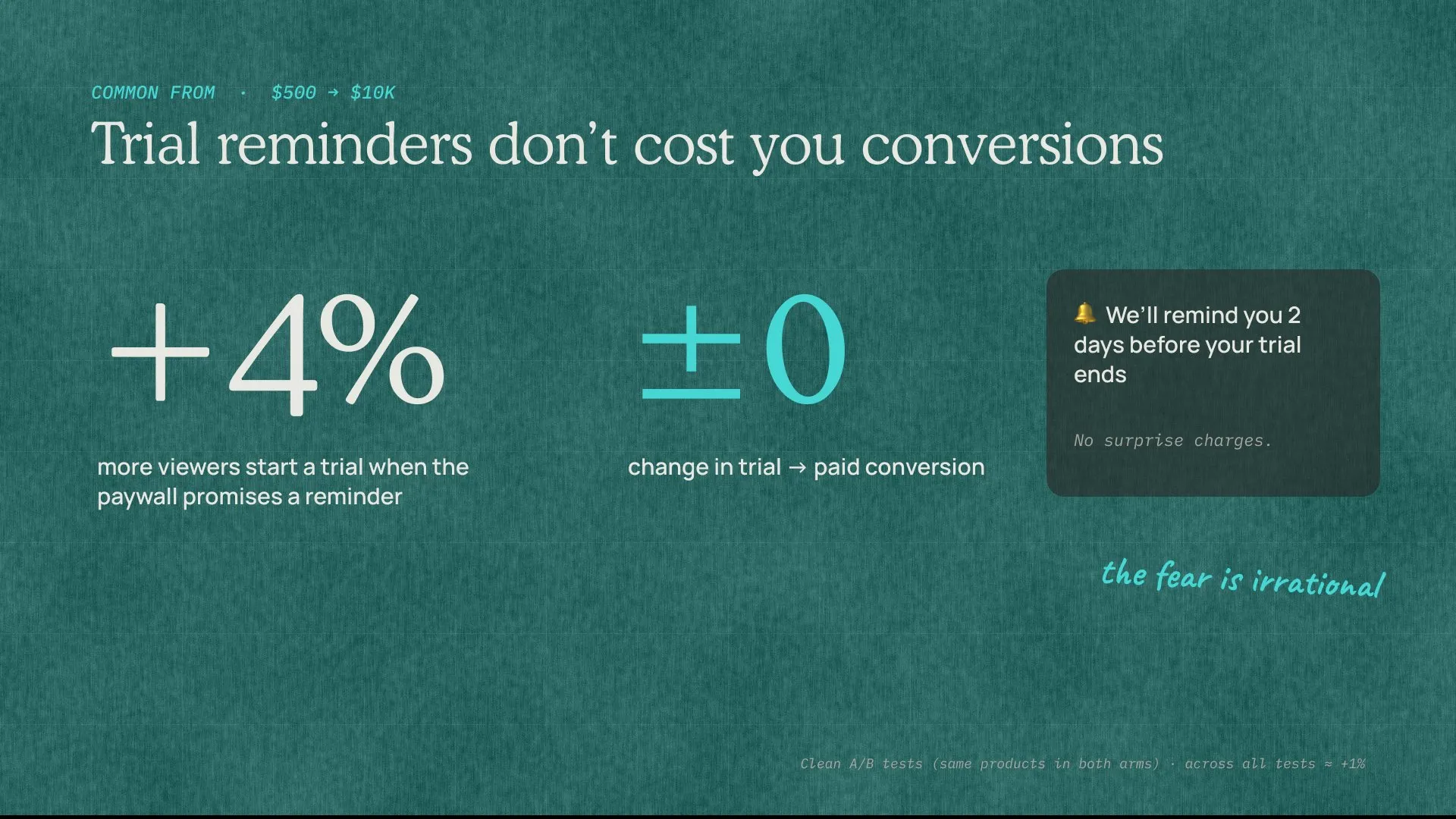
The easiest thing to do now: add a trial reminder. When the paywall promises a reminder and you send it, 4% more viewers start a trial, and trial-to-paid conversion doesn't change. A lot of people fear that a reminder makes users cancel. Statistically, that fear is irrational. If you're on Superwall, the paywall can schedule the reminder as a local notification, so you don't need to set up push notifications.
$10K to $100K: longer trials, more testing
From $10K to $100K, the median trial goes from 3 days to 7, trial to paid goes from 25% to 30%, tests per app go from 4.9 to 15 a year, and apps using recovery offers go from 13% to 19%.
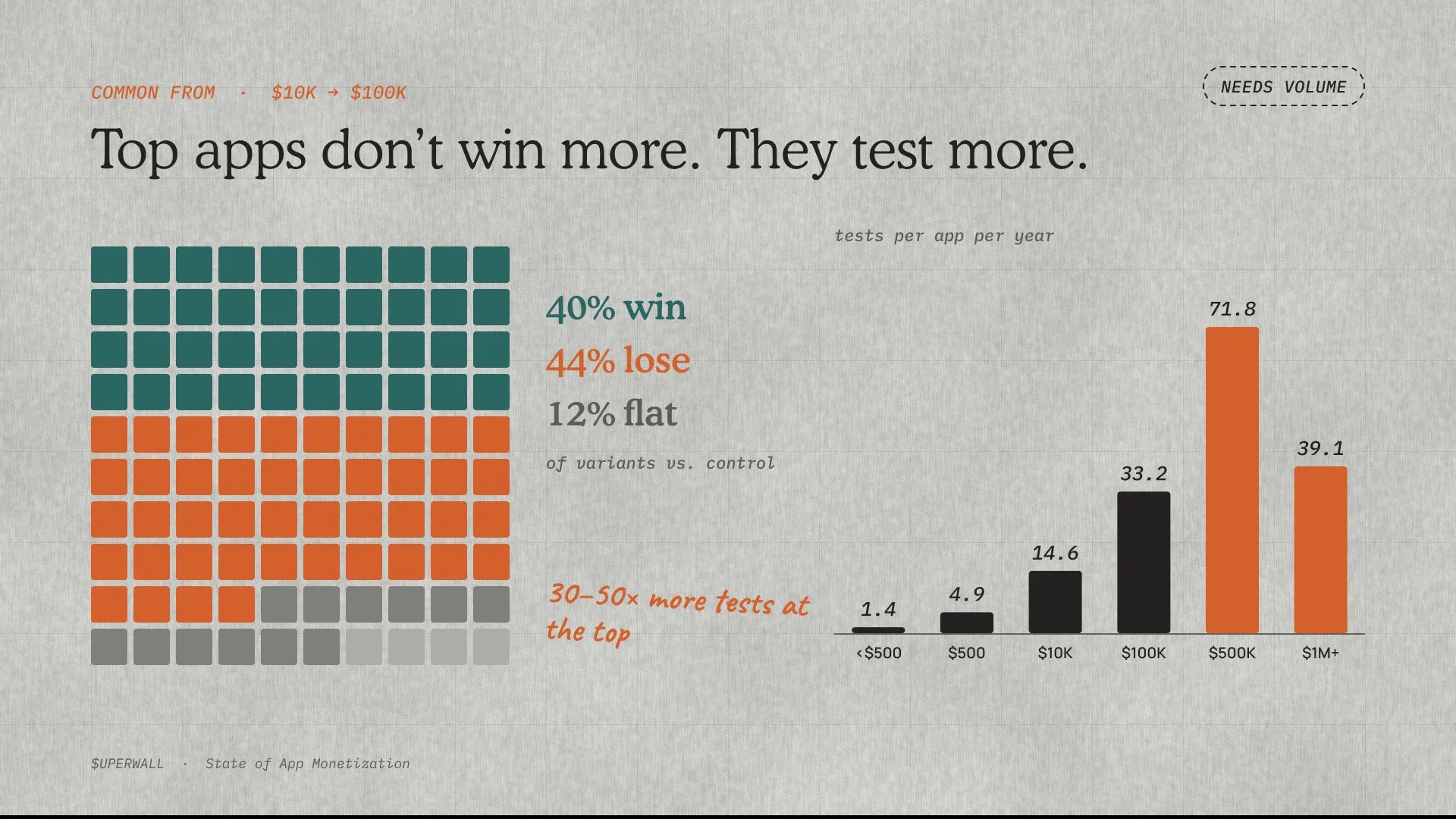
We get tests wrong all the time. Across Superwall, 40% of variants beat their control, 44% lose and 12% are flat. Top apps don't win more often. If anything, the win rate drops a little as revenue goes up. They just test far more: apps at $500K a month run about 72 tests a year, against 1.4 for apps under $500.
Top apps don't win more. They test more.
You don't know what you don't know, and testing is how you find out. A test that loses still teaches you something, as long as the hypothesis and the variants are clean.
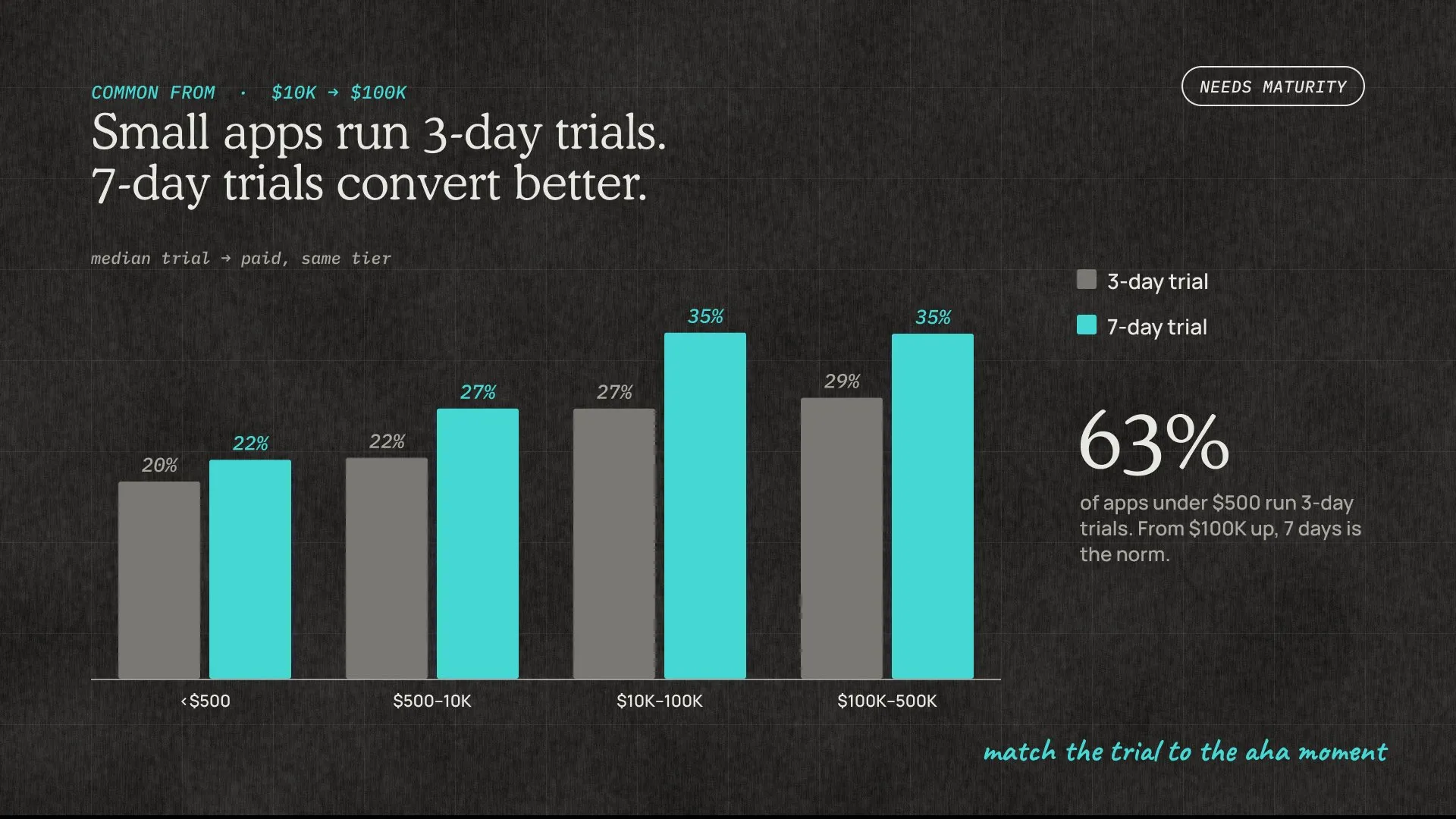
63% of apps under $500 a month run 3-day trials. They send a fast ROAS signal back to the ad platform, which helps while you're looking for a model that works. From $100K up, 7 days is the norm. Trial to paid rises with revenue for both, but faster for 7-day trials: at $100K–$500K it's 35% against 29%. Match the trial to your app's aha moment.
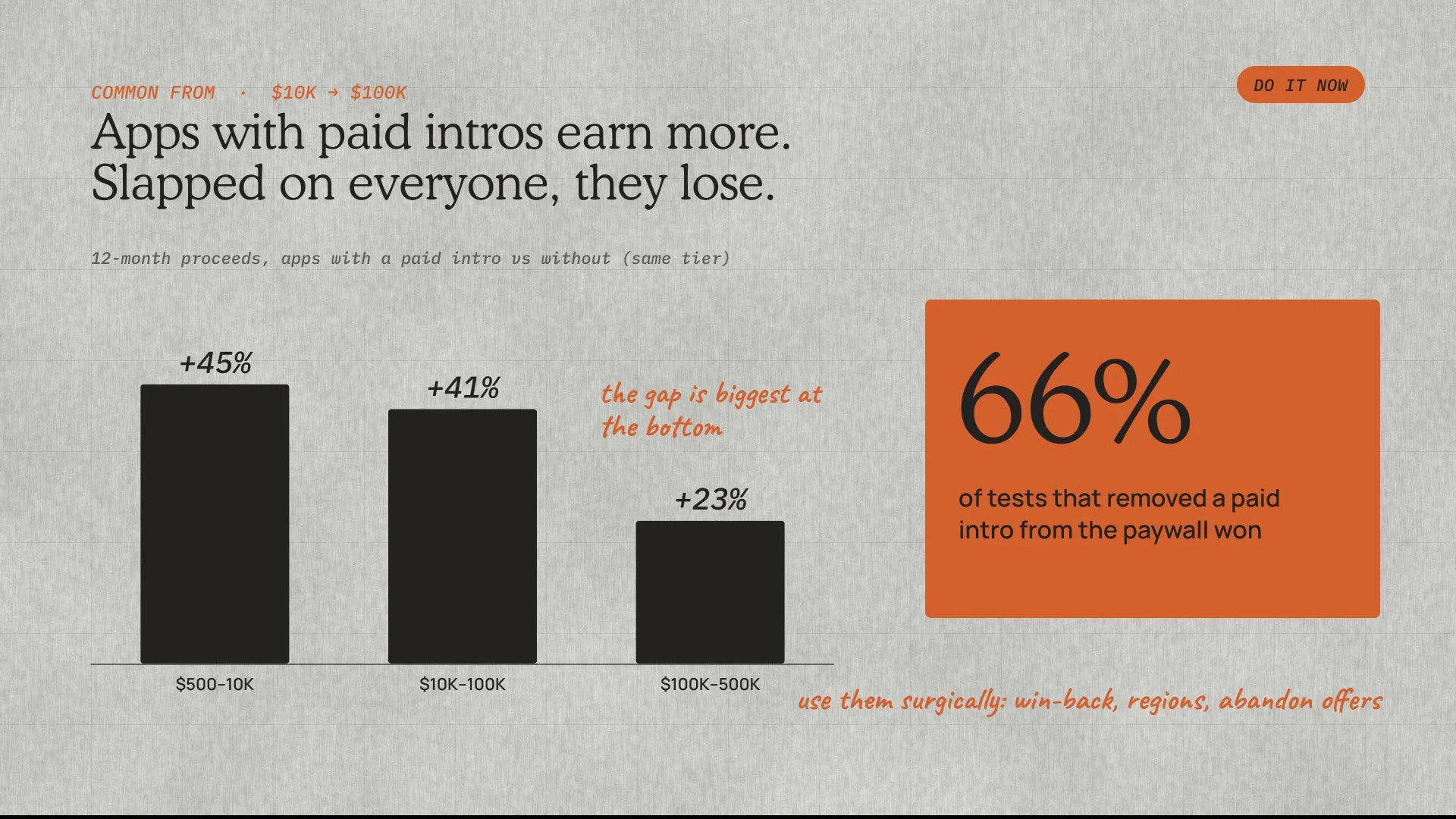
Paid intro offers, like your first month for $3.99, are worth doing now, but surgically. Apps that use one earn 45% more over 12 months at $500–$10K than apps that don't, 41% more at $10K–$100K and 23% more at $100K–$500K. Slapped on everyone, though, they lose: 66% of tests that removed a paid intro from the main paywall won. Use them for winbacks, specific regions and abandon offers.
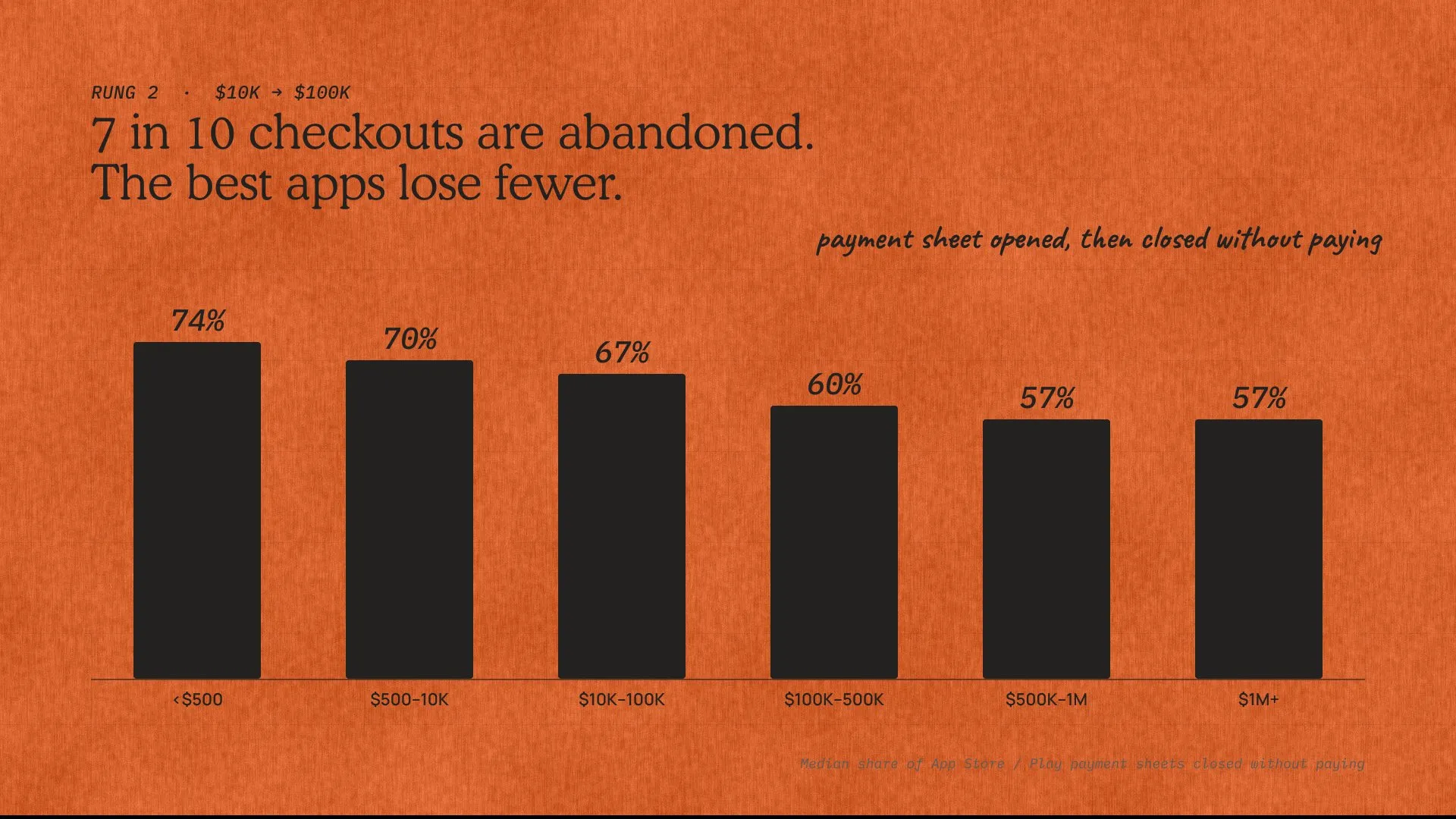
7 in 10 checkouts are abandoned, meaning the payment sheet opened and closed without a purchase. People abandon for lots of reasons: the price, wanting a longer trial, or just tapping through an onboarding flow that was pasted together. The best apps lose fewer, and abandonment falls with every rung, from 74% to 57%. Around 50% I'm not worried something is broken. Past 70% I start to get concerned. I've never seen an app get below about 30%.
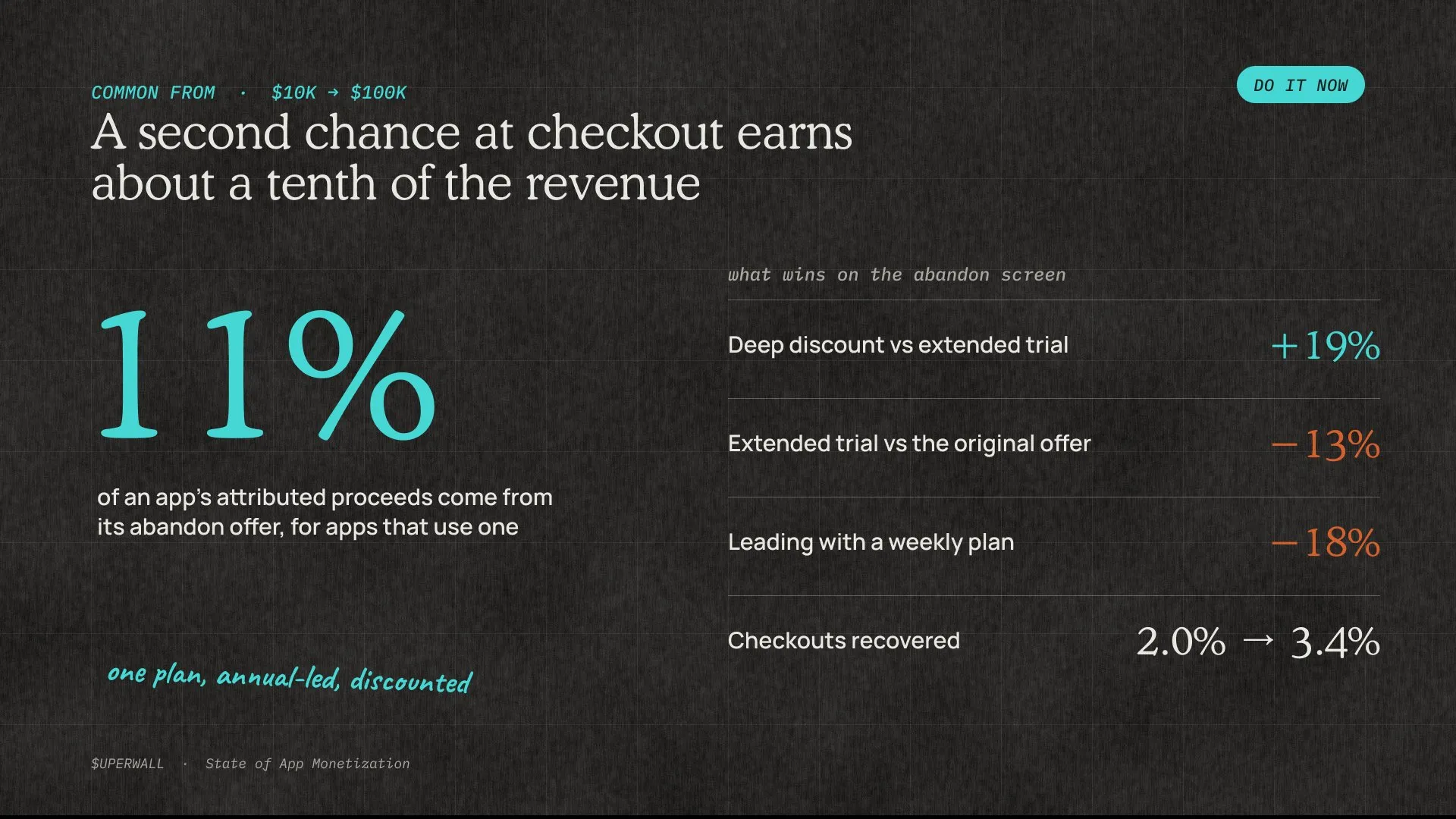
So give people a second chance. Apple allows a tasteful one-time offer when someone abandons checkout; what it doesn't allow is nagging. For apps that use one, the abandon offer brings in about 11% of attributed proceeds, and the share of checkouts recovered goes from 2.0% to 3.4% as apps climb. My personal favorite is an extended trial, but the data disagrees: a deep discount beats an extended trial by 19%. The winning pattern is one plan, annual-led, discounted.
$100K to $500K: multi-page flows, higher prices
From $100K to $500K, apps using multi-page paywalls go from 23% to 44%, the median US annual price goes from $44.99 to $59.99, the median monthly price from $9.99 to $12.49, and tests per app from 15 to 33 a year.
Multi-page paywalls go mainstream at $100K: 44% of apps at that tier use one, and 55% at $500K. A multi-page paywall tells a better story between a personalized onboarding flow and the price. Against single-page paywalls they win 52% of tests, usually with at least a 5% lift in ARPU, and often 7% to 9%. You need the volume to run the test.
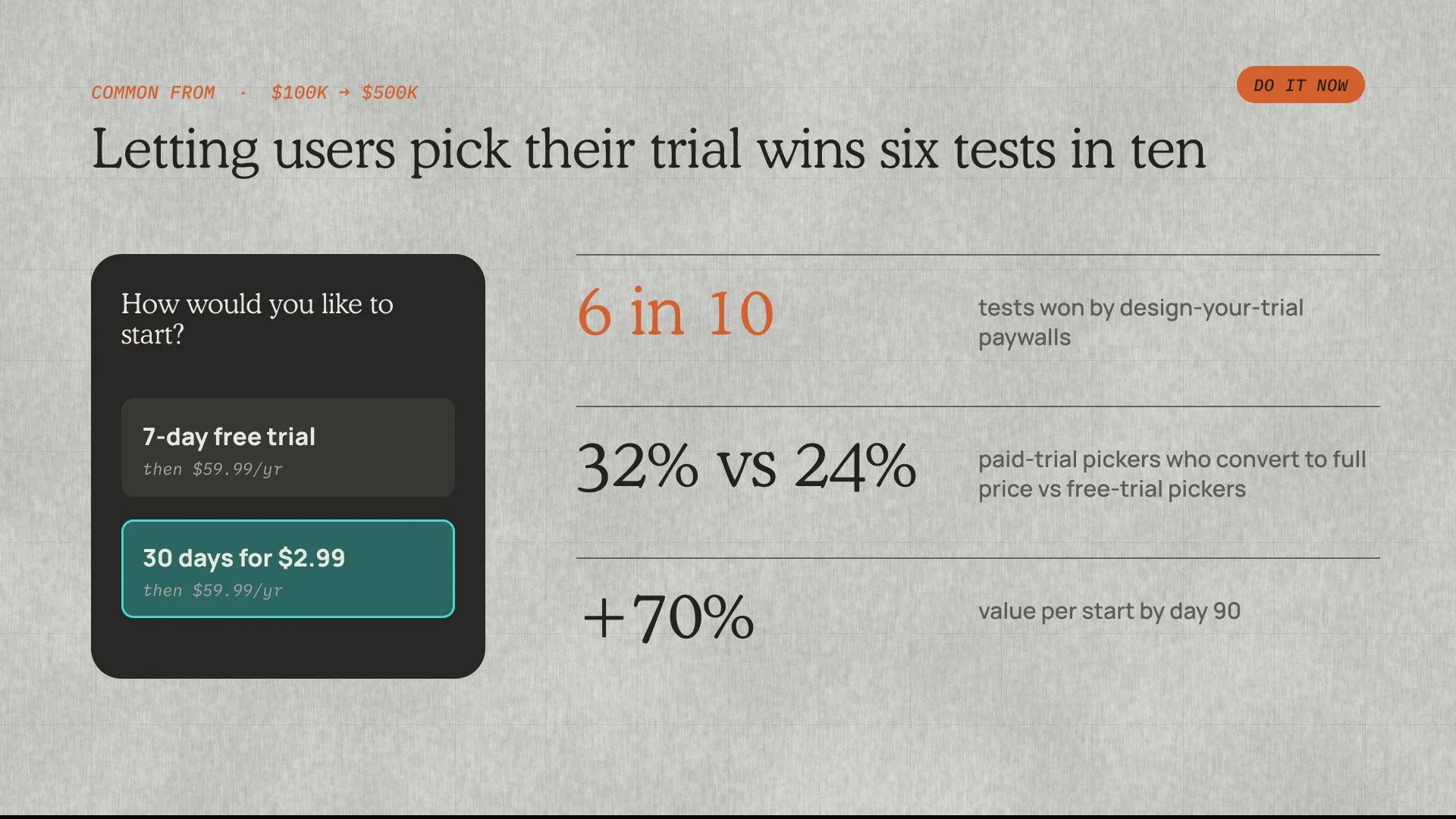
One you can do now: a design-your-trial paywall. It asks how the user wants to start, for example a 7-day free trial or 30 days for $2.99, with the same renewal price either way. It's one of my favorite paywalls to run, and it wins six tests in ten. Users who pick the paid trial convert to full price 32% of the time, against 24% for the free trial, and by day 90 a paid start is worth 70% more.
Prices rise as apps climb. Weekly plans top out around $7 to $8. The annual plan moves most, from a median $34.99 under $500 a month to $59.99 from $100K to $1M. I work with apps charging $100 a year, and one charging $600. Your product, marketing and acquisition all get better as you grow, so price test every six to nine months. I often see customers whose product changed dramatically in the last year, who haven't run a price test in two. Give price tests time: let the first month of renewals land before you read cancellations as a proxy for retention.
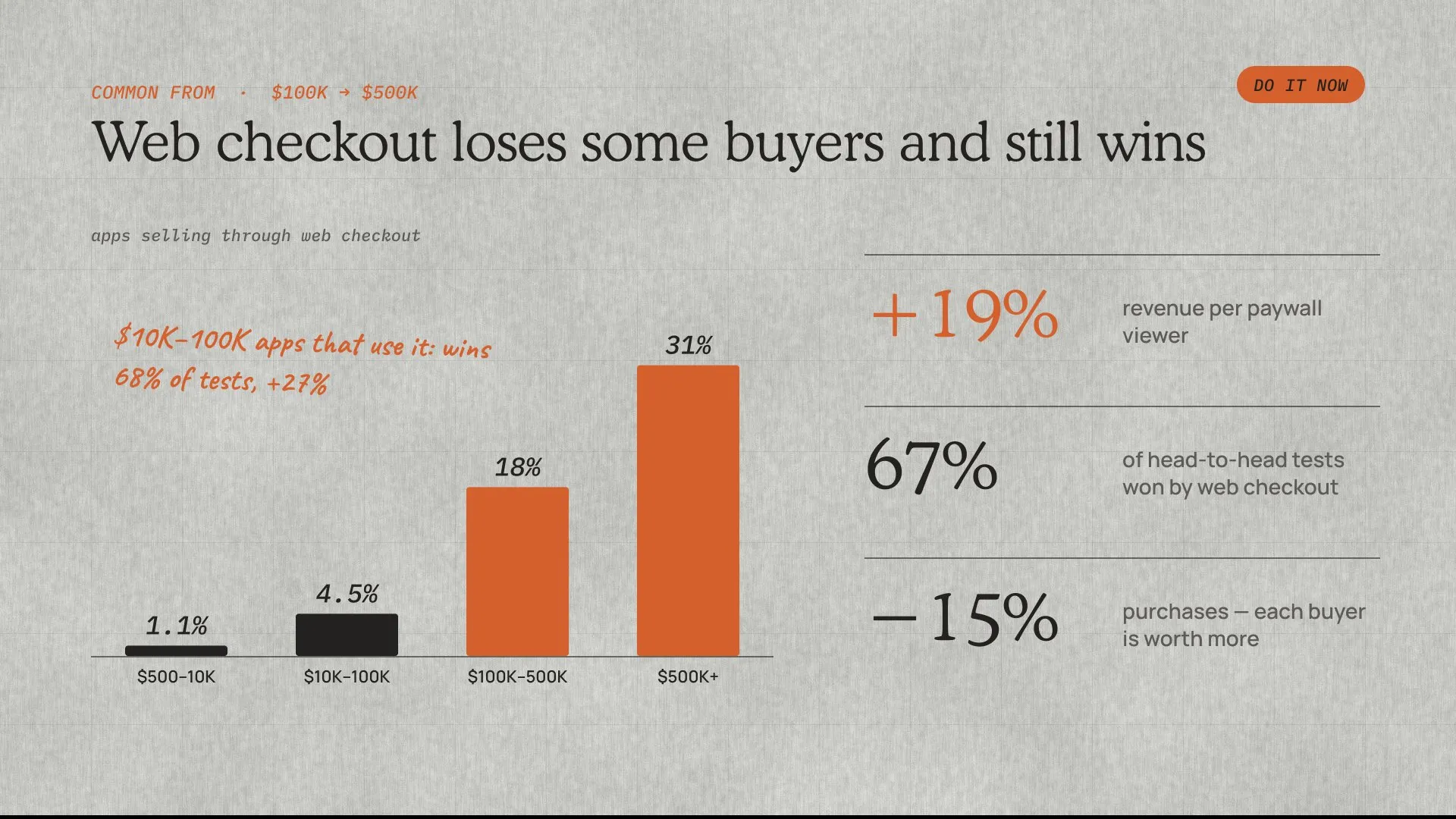
App2web is something I'd do now, with one condition: if you're in Apple's Small Business Program, it's probably not worth it. Apps at $100K a month and up usually aren't, and web checkout use climbs with revenue, to 31% of apps at $500K and above. The added friction of a Stripe or Paddle checkout costs you about 15% of purchases. But each buyer is worth more, so revenue per paywall viewer is 19% higher on average, and the floor is usually around 11%. In head-to-head tests against Apple's in-app purchase, web checkout won 67% of the time.
$500K to $1M+: onboarding and choice
At the top, starts from onboarding go from 48% to 56%, apps showing three or more products go from 43% to 73%, and apps personalizing their paywalls go from 42% to 71%. That doesn't mean a paywall with six products on it, which is just decision fatigue. It means more ways to convert, offered at different moments.
Tests per app actually drop, from 72 to 39 a year. That's not because tests stop working. At this size each test carries more risk and takes longer to mature, so apps choose them more carefully.
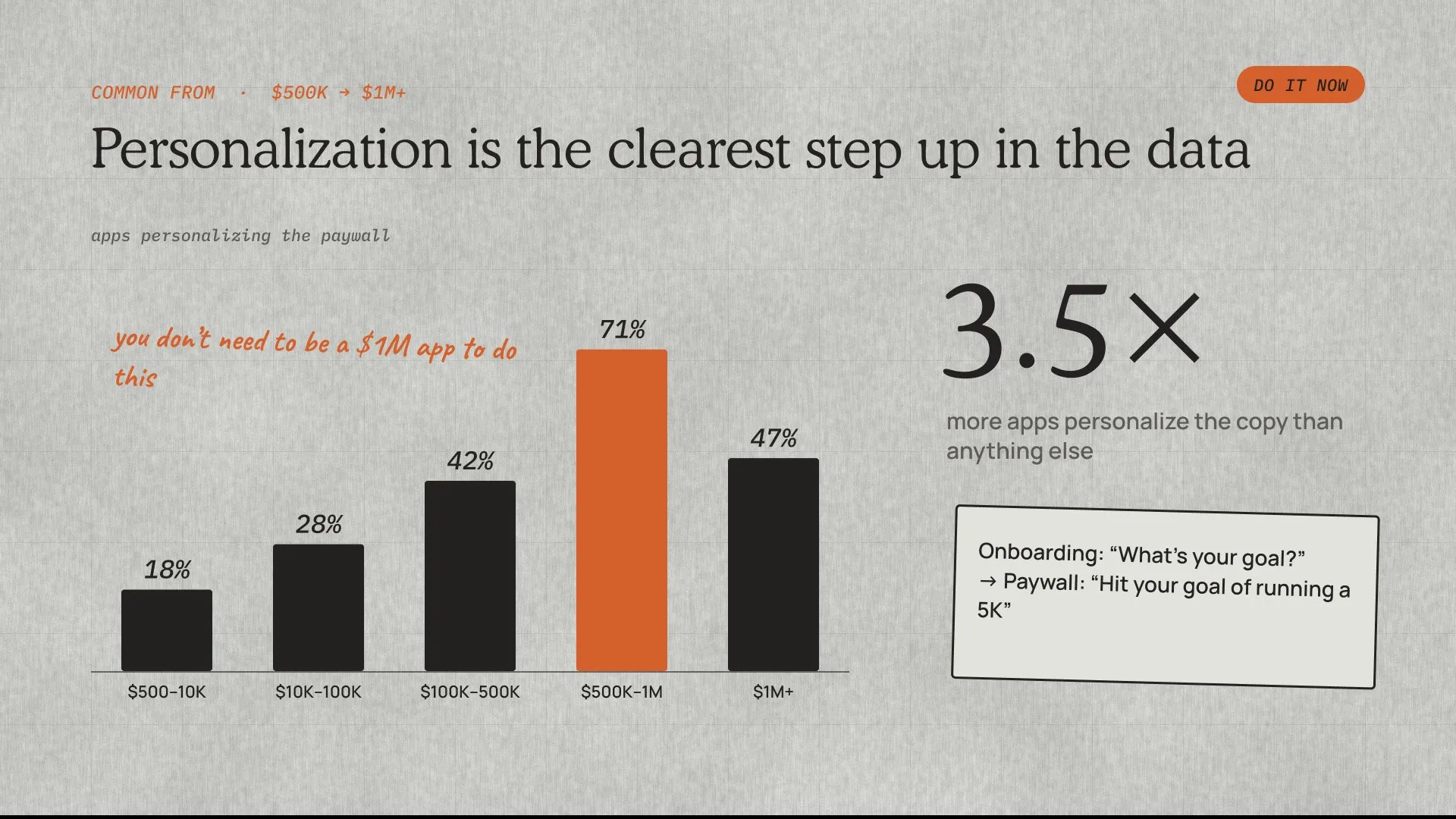
Personalization is the clearest step up in the data, and you don't need to be a $1M app to do it. Ask a simple question in onboarding, like "what's your goal?", and put the answer on the paywall: "Hit your goal of running a 5K." Apps personalize the copy 3.5 times more than anything else, including which products or intro offers they show. I tell every customer: send every onboarding answer that isn't personal data to Superwall as a user attribute, so you can personalize on it, or at least look for the signal.
Keep the subscribers you have
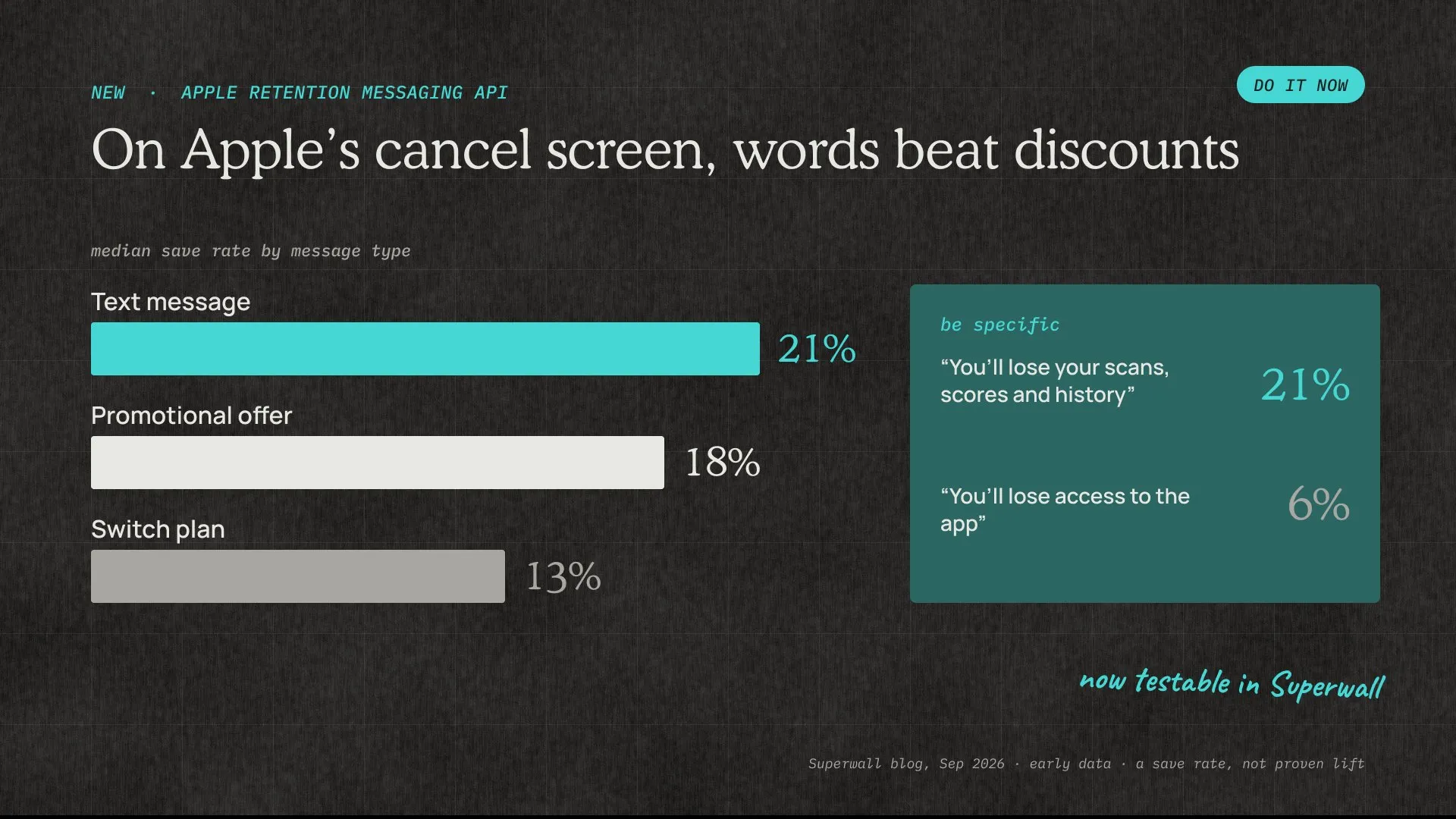
Apple's new retention messaging API lets you show a message on the cancel screen, and at every revenue stage, words beat discounts. A plain text message saves a median 21% of subscribers, against 18% for a promotional offer and 13% for switching plans. It's early data, and a save rate rather than a proven lift, but it's now testable in Superwall.
Be specific. "You'll lose access to the app" is true, but it's weak loss aversion, and it saves 6%. "You'll lose your scans, scores and history" saves 21%. Make the loss tangible, or speak to who they want to be: "Are you sure you want to give up on your fitness goals?"
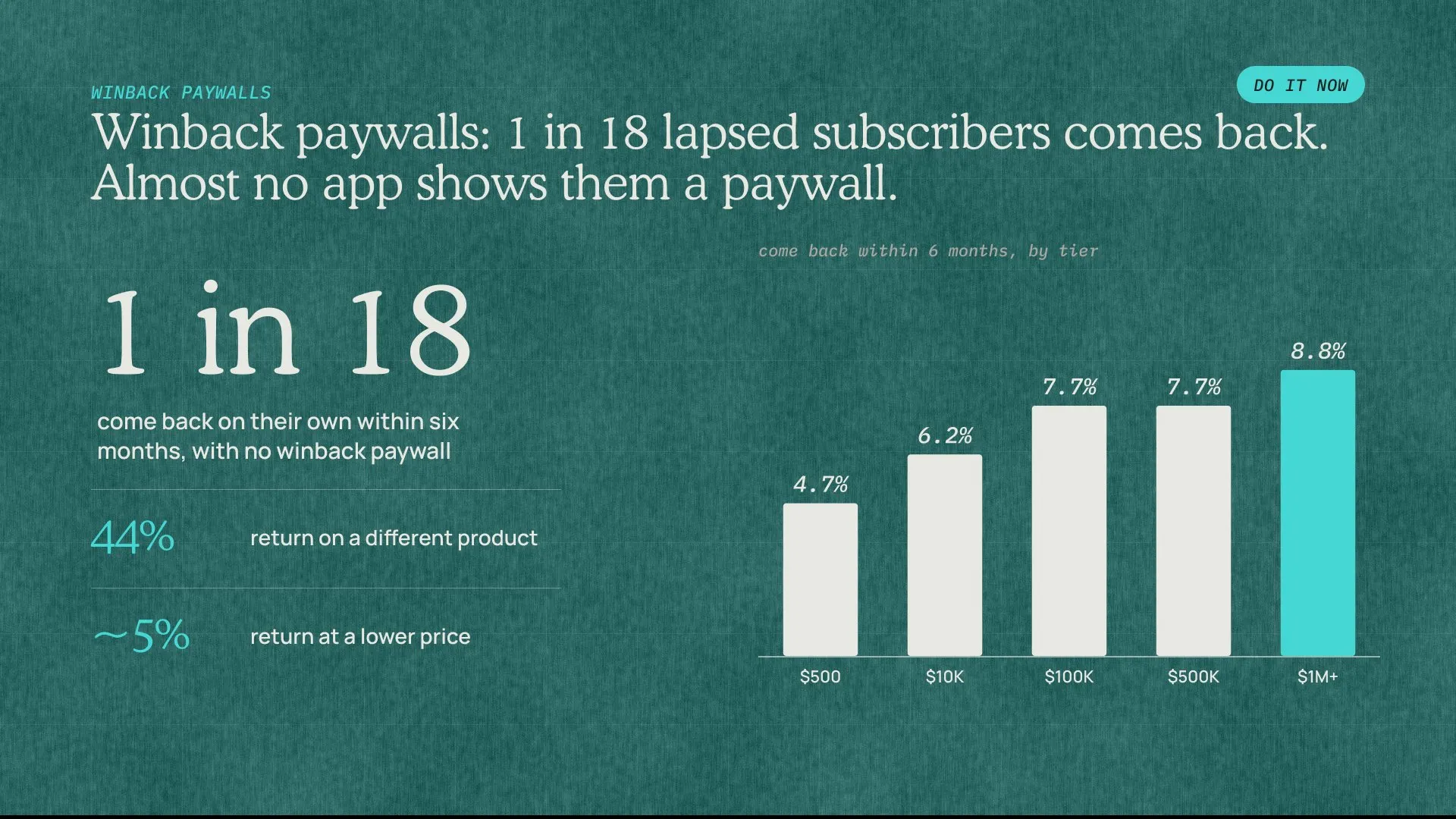
When I ask a room who has a paywall for lapsed subscribers, almost nobody does. But 1 in 18 come back on their own within six months, and at $1M+ apps it's 8.8%. When they return, 44% pick a different product and about 5% come back at a lower price. Look at their subscription status and show them a paywall that says welcome back. It doesn't need different products; different copy is enough. A winback paywall is one of the easiest wins at every revenue tier.
Most of what top apps do, you can do Monday
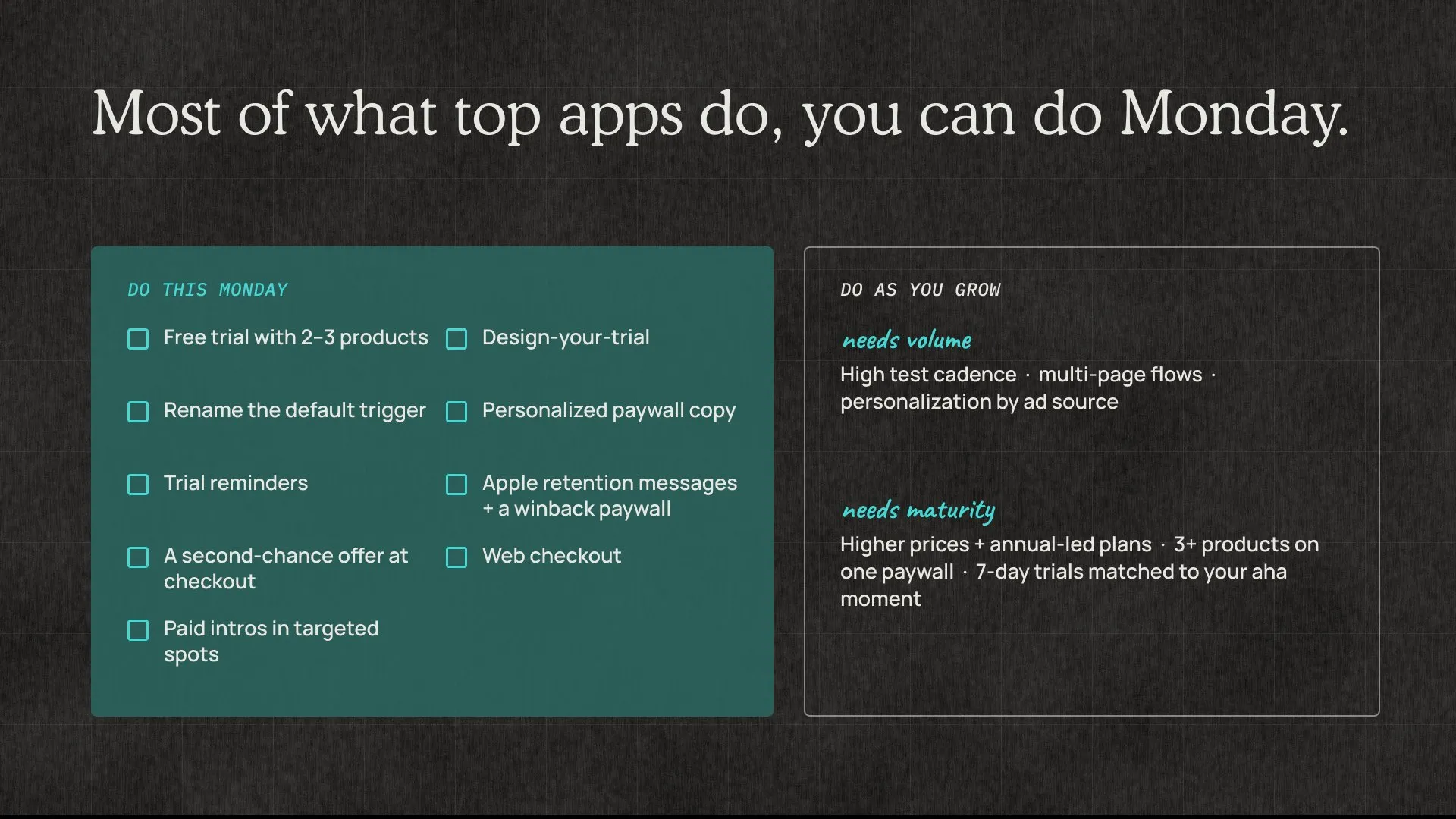
Do this Monday:
- A free trial, with two or three products.
- Your own paywall trigger, instead of the default.
- Trial reminders.
- A second-chance offer at checkout.
- Paid intros, in targeted spots.
- A design-your-trial paywall.
- Personalized paywall copy.
- Apple retention messages, and a winback paywall.
- Web checkout.
Some things need volume: a high test cadence, multi-page flows, and personalization by ad source. An app at $10K a month probably can't run 72 tests a year, but it can run 30. Others need maturity: higher prices, annual-led plans, three or more products on one paywall, and 7-day trials matched to your aha moment.
Most important of all: run more experiments. Each idea on this list is its own hypothesis and its own variant, so don't blend them together. Find out how each one moves your app and your users. If there's one line that runs through every app I work with, it's this: the apps that make more money run far more experiments.